العربية
 English
 हिन्दी
 Malay
Malay اُردُو
 বাংলা
বাংলা Français
 Português
 Italiano
 Nederlands
 Deutsch
 Русский
 Español
 中文
中文 ไทย
ไทย Türkçe
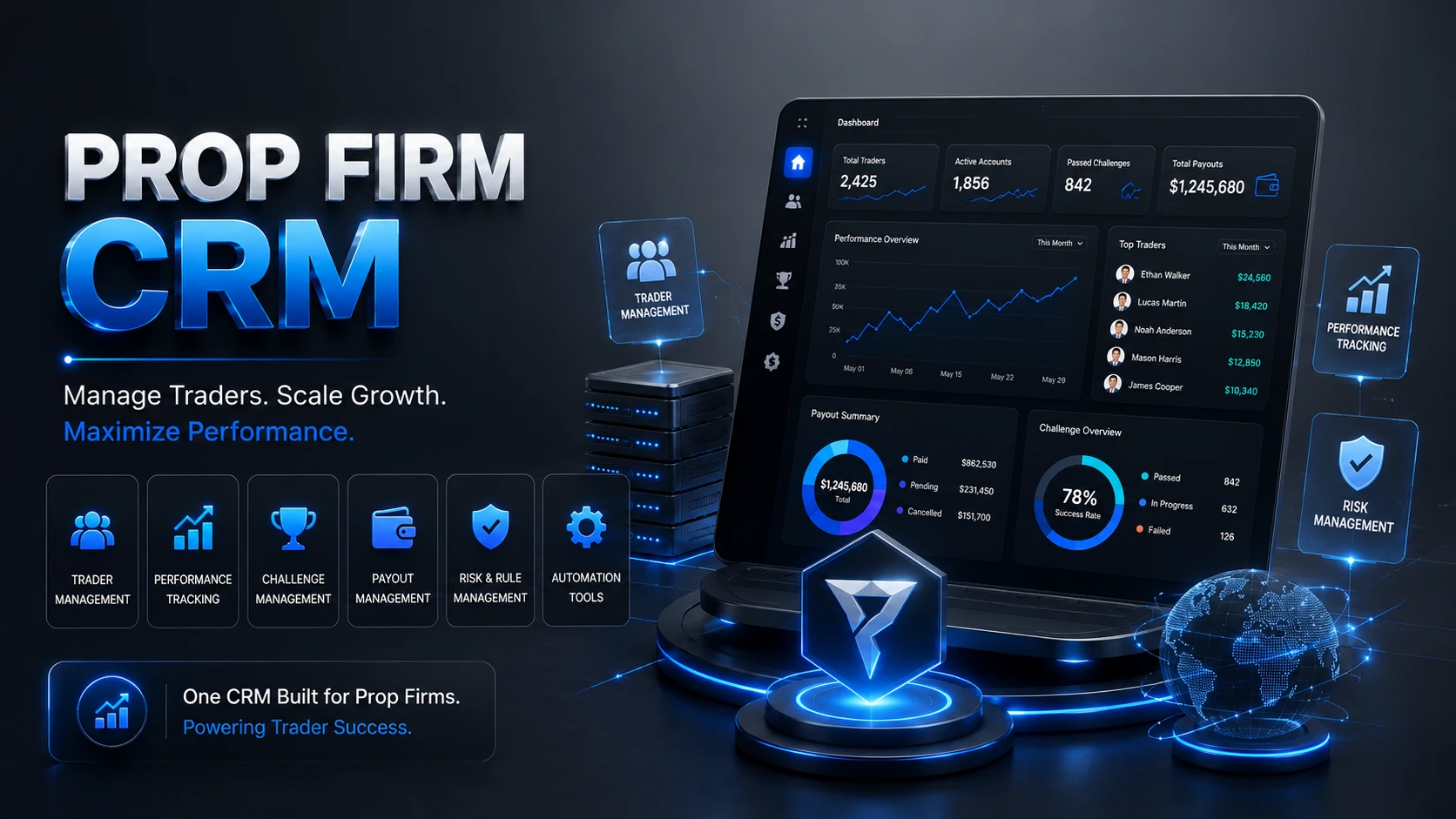
Prop Firm CRM

Added By BridgingFX
Product overview
Everything you need to know about this product
Prop Firm CRM
Running a modern funded trader program requires far more than simply selling trading challenges. Behind every successful prop firm is a complex operational environment involving trader registration, payments, KYC, challenge configuration, trading-account provisioning, real-time performance monitoring, rule enforcement, account transitions, funded-account management, payouts, affiliates, support, and reporting.
Prop Firm CRM brings these critical processes together into one centralized platform designed specifically around the operational requirements of a modern proprietary trading firm.
Instead of relying on spreadsheets, manual account checks, disconnected payment systems, separate affiliate platforms, and delayed performance reports, Prop Firm CRM connects the complete trader lifecycle into one automated environment. From the moment a trader purchases a challenge to the moment they progress through evaluation and receive a funded account, the platform provides the tools needed to manage the journey efficiently.
Whether your firm is launching its first evaluation program or managing thousands of traders across multiple challenge models, Prop Firm CRM provides a scalable operational backbone for managing traders, trading accounts, risk rules, payments, affiliates, support, and performance data.
Complete Prop Firm Management
Prop Firm CRM is designed to manage the entire operational lifecycle of a funded trader program.
Trader registration, challenge purchases, KYC, account provisioning, trading activity, evaluation results, rule violations, funded accounts, payouts, affiliate commissions, certificates, and customer communication can all be connected within one environment.
This creates a centralized system where your team can understand exactly where each trader is in their journey and what action is required next.
Trader Registration
The trader journey begins with registration.
Prop Firm CRM provides structured registration workflows that allow traders to create accounts, provide the required information, select their preferred challenge, and begin the onboarding process.
Registration data is stored within the trader's centralized profile so it can be used throughout the evaluation and funded-account lifecycle.
Challenge Purchase Management
Once a trader selects a challenge, the purchase process can be connected directly to the CRM.
Challenge information, payment status, account configuration, and trader details can be associated automatically, reducing the need for manual data entry.
This creates a smoother transition from purchase to account creation.
Multiple Challenge Models
Every prop firm has its own evaluation strategy.
Prop Firm CRM supports configurable challenge structures including one-step challenges, two-step challenges, and instant funding programs, allowing operators to create different products for different types of traders.
Each challenge can have its own rules, targets, drawdown parameters, account sizes, pricing, duration, and progression requirements.
One-Step Challenges
One-step evaluations can be configured around a single performance stage.
Administrators can define the required objectives, maximum drawdown, daily loss limits, trading requirements, minimum trading days, and other applicable rules.
The system can automatically monitor performance against the configured criteria.
Two-Step Challenges
For firms using multi-stage evaluation programs, the CRM can manage separate challenge phases.
Each stage can have its own profit target, risk limits, minimum trading requirements, duration, and other conditions.
When a trader successfully completes one phase, the system can automatically move the account into the next stage according to the configured workflow.
Instant Funding
For firms offering instant funding, traders can bypass traditional evaluation stages where the business model permits.
The CRM can support separate instant-funding configurations with their own account sizes, drawdown limits, profit-sharing structures, trading rules, and payout requirements.
This allows multiple funding models to operate within the same platform.
Flexible Challenge Configuration
Prop Firm CRM is designed to allow administrators to configure challenge products without requiring developers for every operational change.
Administrators can adjust supported parameters such as account size, profit targets, drawdown limits, daily loss thresholds, minimum trading days, challenge duration, pricing, and other business rules according to the firm's model.
This provides greater flexibility as the firm evolves.
Automated Account Provisioning
Once a challenge has been purchased and payment requirements are satisfied, trading-account provisioning can be automated through the connected trading infrastructure.
The CRM can create or assign the appropriate account, apply the relevant configuration, and connect the account to the trader's profile.
This significantly reduces manual account-creation work.
Trading Platform Integration
Real-time connectivity with trading platforms is a core component of a modern prop firm operation.
Prop Firm CRM can integrate with supported trading infrastructure to receive account balances, equity, trades, drawdown, performance information, and other relevant trading data.
This allows the CRM to become the operational layer connecting traders with the firm's trading environment.
Real-Time Trader Monitoring
Prop firms need to know what is happening while traders are actively trading.
Real-time monitoring allows the platform to track relevant account information and evaluate it against the configured challenge or funded-account rules.
This gives administrators greater visibility into trader performance throughout the lifecycle.
Automated Drawdown Monitoring
Drawdown is one of the most important risk parameters within a prop firm.
Prop Firm CRM can continuously monitor account performance against configured maximum-drawdown thresholds.
When a trader approaches or exceeds a defined limit, the system can trigger alerts or rule-based actions according to the firm's configuration.
Daily Loss Monitoring
Daily loss limits can also be monitored automatically.
Instead of relying on manual calculations or end-of-day spreadsheets, the system can evaluate relevant trading-account information against the configured daily-loss rules.
This allows potential breaches to be identified much closer to the time they occur.
Automated Rule Enforcement
Manual rule checking becomes increasingly difficult as trader volume grows.
Prop Firm CRM can automatically evaluate trading activity against predefined challenge and funded-account rules.
Depending on the configured trading environment, rules can include drawdown, daily loss, minimum trading days, trading restrictions, position limits, exposure limits, and other applicable conditions.
Instant Rule Violation Detection
Rule violations can be detected as trading activity occurs rather than discovered days later during manual review.
When a configured condition is triggered, the system can record the event and initiate the appropriate workflow.
This helps create a more consistent evaluation process.
Configurable Trading Rules
Different prop firms have different business models.
The CRM allows rules to be configured around the firm's specific evaluation criteria rather than forcing every program into the same template.
This can include account-level rules, challenge-stage rules, funded-account rules, product-specific requirements, and other supported parameters.
Trader Progress Tracking
Every trader can have a centralized progress record showing their current stage, account status, performance, rule status, and relevant milestones.
Administrators can quickly determine whether a trader is active, progressing, failed, passed, funded, suspended, or in another configured state.
Automated Challenge Progression
When a trader meets the requirements for a specific stage, the system can automatically update their status and initiate the next step in the workflow.
For multi-stage challenges, this can include moving traders from one evaluation phase to another without requiring manual intervention.
Automated Pass and Fail Processing
Once a trader meets or breaches the configured criteria, the CRM can automatically process the corresponding outcome.
Successful traders can progress toward funding, while failed accounts can be marked accordingly based on the firm's rules.
This creates a more consistent and scalable evaluation process.
Automated Certificates
When a trader successfully completes a challenge, certificates can be generated and issued automatically according to the firm's configuration.
This removes the need for staff to manually prepare and send completion documents for every successful trader.
Funded Account Issuance
Successful traders can be automatically moved from the evaluation environment into the funded-account workflow.
The system can create or assign the appropriate funded account, apply the relevant settings, and update the trader's status.
This minimizes delays between successful evaluation and funded-account activation.
Funded Trader Management
The trader journey does not end after passing the challenge.
Prop Firm CRM continues to manage the trader during the funded stage, providing visibility into performance, risk, payouts, account status, and other relevant activity.
This creates a complete lifecycle rather than treating evaluation and funding as separate systems.
Funded Account Monitoring
Funded accounts can be monitored using the same centralized environment.
Administrators can track relevant performance indicators, drawdown, trading activity, account status, and risk parameters throughout the funded period.
Performance-Based Trader Management
Performance information can help firms understand which traders are demonstrating consistent behavior.
Management teams can analyze profitability, drawdown, trading frequency, consistency, and other configured metrics to develop a more complete picture of trader performance.
Trader Performance Analytics
Detailed analytics allow administrators to evaluate the performance of individual traders as well as the broader trader population.
Reports can include profit and loss, drawdown, win rate, trading volume, account growth, consistency, trading frequency, and other relevant metrics.
Identify High-Performing Traders
Historical and real-time performance data can help firms identify traders who demonstrate strong and consistent results.
Management can use these insights to understand trader behavior and evaluate whether existing challenge structures and criteria are aligned with actual performance patterns.
Evaluation Criteria Analysis
A prop firm's challenge rules should be based on meaningful performance data.
By analyzing trader outcomes, pass rates, failure rates, drawdowns, trading behavior, and funded-account performance, operators can identify potential areas for refinement.
This allows evaluation criteria to evolve based on observed data rather than assumptions alone.
Trader Risk Profiles
Traders can be analyzed according to their risk characteristics and trading behavior.
Risk profiles can help firms identify patterns involving aggressive exposure, high drawdown, frequent trading, concentrated positions, or other configured indicators.
This creates greater visibility into the overall trader population.
Trader Segmentation
Traders can be segmented according to challenge type, account size, region, performance, funding stage, affiliate source, risk profile, or other business attributes.
Segmentation makes it easier to analyze specific groups and create targeted operational workflows.
Multiple Account Management
A single trader may have more than one account or participate in multiple products.
Prop Firm CRM can maintain relationships between traders and their associated accounts, challenges, funded accounts, and historical activity.
This provides a consolidated view of the trader relationship.
Challenge Account History
Each trader can maintain a historical record of previous challenges, outcomes, account configurations, rule violations, and funded-account transitions.
This helps administrators understand the complete history rather than evaluating the trader based only on their current account.
Payment Integration
The challenge purchase process can be connected to payment infrastructure.
Supported payment methods can be integrated so payment status can be synchronized with challenge registration and account provisioning.
This reduces the need for manual reconciliation between sales and operations.
Multi-Currency Support
Prop firms may sell challenges to traders across different markets.
The CRM can support configured currencies for pricing, payments, reporting, and other financial workflows according to the firm's requirements and payment infrastructure.
Refund Management
Where refunds are supported by the firm's commercial terms, refund workflows can be connected to customer and transaction records.
This allows finance and support teams to maintain a centralized history of refund-related activity.
Payout Management
Payouts are a critical part of the funded-trader experience.
Prop Firm CRM can manage payout requests, review processes, approval workflows, payout status, transaction records, and relevant trader information from one environment.
Automated Payout Workflows
Once a trader becomes eligible for a payout according to the firm's configured rules, the platform can initiate the appropriate workflow.
Eligibility checks, approvals, payment processing, and status updates can be connected to reduce manual administration.
Profit-Sharing Management
The CRM can support configured profit-sharing structures between the firm and funded traders.
Relevant calculations can be associated with trader performance and payout workflows according to the firm's commercial model.
Payout History
Every payout can be retained as part of the trader's financial and account history.
Administrators can review previous requests, approvals, amounts, statuses, and related transaction information.
This improves transparency and simplifies operational review.
Affiliate Management
Affiliate networks can be an important acquisition channel for prop firms.
Prop Firm CRM includes affiliate-management capabilities that can connect referral activity, customer registration, challenge purchases, commissions, and partner performance.
Automated Affiliate Tracking
Referral sources can be tracked from the initial click or referral through registration and challenge purchase.
This allows firms to understand which partners are generating customers and revenue.
Automatic Commission Tracking
Affiliate commissions can be calculated according to configured structures.
The system can maintain commission records and provide visibility into partner earnings, reducing the need for manual spreadsheet calculations.
Affiliate Dashboards
Partners can access relevant performance information through dedicated dashboards.
Depending on the configured setup, affiliates can view referrals, conversions, commissions, campaign activity, and payout-related information.
Multi-Level Affiliate Structures
For businesses using more advanced partner models, the CRM can support configurable multi-level affiliate relationships where required.
Commission relationships and partner hierarchies can be managed within the same ecosystem.
Affiliate Performance Analytics
Management can analyze affiliate-generated registrations, challenge purchases, conversion rates, revenue, commissions, and other performance metrics.
This helps identify the partners and campaigns generating meaningful results.
Trader Support Management
Customer support is an essential part of the prop firm experience.
Support teams can manage questions, technical issues, account-related requests, payment concerns, challenge questions, and other customer interactions from a centralized environment.
Unified Customer Communication
Email, WhatsApp, Telegram, and other supported communication channels can be connected to customer profiles.
This allows support and sales teams to understand previous conversations before responding.
Automated Notifications
The CRM can send automated notifications for important trader events.
These may include challenge purchases, account creation, challenge progression, rule violations, challenge completion, funded-account activation, payout updates, and other configured milestones.
Trader Onboarding
New traders can be guided through a structured onboarding process.
The CRM can automate registration, payment confirmation, KYC requirements, account provisioning, educational information, platform instructions, and other configured onboarding steps.
KYC Management
Where KYC is required, verification workflows can be connected directly to the trader lifecycle.
Document collection, verification status, manual review, approval, rejection, and document expiry can be tracked from the trader profile.
Compliance Records
Relevant customer and verification information can be retained with appropriate access controls and audit records.
This creates a centralized record of important compliance-related activity while allowing the firm's processes to reflect applicable requirements.
Admin Dashboard
Administrators receive a centralized view of the prop firm's operations.
The dashboard can display active traders, challenge sales, account statuses, performance data, rule violations, payouts, affiliate activity, KYC status, support requests, and other important KPIs.
Real-Time Business Intelligence
Management should not have to wait until the end of the month to understand what is happening.
Real-time dashboards can provide visibility into trader activity, challenge performance, sales, payouts, conversion rates, and operational metrics.
Challenge Sales Analytics
Analyze how individual challenge products are performing.
Reports can compare sales volume, revenue, pass rates, failure rates, refunds, trader behavior, and other metrics across different challenge types.
Pass and Fail Analytics
Understanding why traders pass or fail can help firms refine their evaluation programs.
The CRM can analyze outcomes by challenge type, account size, region, affiliate source, trader segment, and other configured dimensions.
Trader Lifecycle Analytics
Monitor the complete trader journey from registration to challenge purchase, evaluation, pass/fail, funded status, and payout.
This provides management with a clearer understanding of where traders succeed, where they drop out, and where operational improvements may be needed.
Automated Reporting
Regular operational reports can be generated around trader activity, financial performance, affiliate performance, payouts, challenges, rule violations, and other configured metrics.
This reduces manual report preparation and gives management more consistent access to business information.
Role-Based Access
Different teams require different levels of access.
Sales teams may need customer and challenge information. Operations may need account-management tools. Finance may need payment and payout information. Compliance may need KYC data. Management may require broader reporting.
Role-based permissions help ensure that users access only the information relevant to their responsibilities.
Audit Trails
Important actions can be recorded through detailed activity logs.
Account changes, rule events, approvals, payouts, administrative actions, configuration changes, and other relevant activities can be retained for historical review.
Fraud and Abuse Monitoring
A scalable prop firm needs visibility into potentially abusive or suspicious activity.
The CRM can support monitoring workflows designed to identify configured patterns such as unusual account activity, repeated rule-related events, suspicious trading behavior, or other signals requiring review.
Potential issues can be flagged for appropriate investigation rather than relying entirely on manual checks.
Rule-Based Alerts
Administrators can configure alerts around important operational and trading events.
Alerts may relate to drawdown, daily loss, account status, payout eligibility, unusual activity, KYC status, payment events, or other configured conditions.
Automated Trader Communications
Routine trader communication can be automated based on lifecycle events.
Messages can be triggered when traders purchase challenges, receive account details, progress between stages, violate rules, pass evaluations, become funded, or submit payout requests.
This keeps traders informed without requiring staff to manually send every update.
Certificates and Trader Recognition
Successful traders can receive automated completion certificates or recognition documents.
These can be branded according to the prop firm's identity and issued as part of the automated progression workflow.
White-Label Prop Firm Experience
Prop Firm CRM can be customized around your brand.
Your logo, colors, communications, trader dashboards, challenge presentation, certificates, and customer-facing experience can be configured to create a consistent branded environment.
The technology works behind your business while the trader experience remains aligned with your identity.
Custom Branding
Your prop firm should not look like a generic software installation.
White-label capabilities allow businesses to create an experience that reflects their own brand, product positioning, challenge structure, and customer journey.
Multi-Brand Management
Organizations operating multiple prop trading brands or product lines can structure their operations around separate business environments while maintaining centralized technology where appropriate.
This can provide greater flexibility for companies operating multiple trading products.
Multi-Country Operations
International prop firms often serve traders across multiple markets.
The CRM can support configurable currencies, languages, regional workflows, communication requirements, and customer segmentation according to the firm's operational model.
Scalable Infrastructure
The platform is designed to support growth from an initial trader base to significantly larger participant volumes.
As trader numbers increase, automation becomes increasingly important for maintaining efficient account management, monitoring, support, payouts, and reporting.
Reduce Spreadsheet Dependency
Spreadsheets can be useful for simple analysis, but they become difficult to maintain when managing thousands of traders and continuously changing trading data.
Prop Firm CRM replaces fragmented manual processes with centralized data, automated calculations, real-time integrations, and structured workflows.
Reduce Manual Operations
From challenge registration and account provisioning to rule monitoring, progression, certificates, affiliate commissions, and payouts, automation reduces repetitive administrative work.
Your operations team can focus more on improving the business rather than repeatedly updating records.
Improve Trader Experience
A trader should not have to wait for manual account setup, unclear status updates, or delayed performance information.
Automated onboarding, real-time dashboards, clear challenge progress, automated notifications, and structured payout workflows create a smoother overall experience.
Build a Data-Driven Prop Firm
The strongest operational decisions come from real data.
Prop Firm CRM gives management access to information about trader behavior, challenge performance, pass rates, failure patterns, payouts, affiliate acquisition, and customer activity.
These insights can support more informed decisions around product design, pricing, risk parameters, marketing, and trader management.
Optimize Your Challenge Products
Different challenge products can be compared using actual performance data.
Analyze which account sizes attract the most traders, which challenges produce the strongest conversion rates, where traders typically fail, and which programs produce sustained funded-account performance.
This creates a feedback loop for continuous product improvement.
Manage Thousands of Traders
The operational requirements of a prop firm change dramatically as trader volume grows.
What can be managed manually with ten traders becomes difficult with hundreds and potentially impossible with thousands.
Prop Firm CRM is designed to automate the processes that become bottlenecks as participation increases, helping the firm maintain centralized visibility and operational control at scale.
Built for Modern Prop Firms
Prop Firm CRM is designed around the realities of a modern funded trading business.
It connects the commercial side of the firm—sales, challenges, payments, affiliates, and customer management—with the operational side—trading accounts, monitoring, risk rules, progression, funded accounts, and payouts.
This creates a much stronger connection between the customer journey and the trading infrastructure behind it.
From Challenge Purchase to Funded Account
The complete trader journey can be connected within one workflow:
Register → Purchase → Verify → Provision → Trade → Monitor → Evaluate → Pass or Fail → Fund → Perform → Request Payout → Approve → Pay.
Every stage can be connected to the relevant customer, trading account, financial record, and operational workflow.
Turn Your Prop Firm Into a Scalable Operation
A successful prop firm is not built only around attractive challenges.
It requires reliable technology, clear rules, automated monitoring, efficient customer management, transparent financial processes, strong affiliate infrastructure, and the ability to handle increasing trader volumes without increasing administrative complexity at the same rate.
Prop Firm CRM provides the technology foundation for bringing these components together.
Build Your Prop Firm With Greater Control
Whether you are launching your first funded-trader program or already managing a large international trader community, Prop Firm CRM provides a centralized environment for managing the entire operation.
Configure one-step, two-step, and instant-funding products. Connect trading platforms. Automate account provisioning. Monitor drawdown and trading rules in real time. Track trader progression. Issue certificates. Manage funded accounts. Process payouts. Track affiliates. Analyze performance. Manage KYC. Support customers. Monitor the business from centralized dashboards.
Less spreadsheet management. Less manual reconciliation. More automation. More visibility. More control.
The Operational Backbone of Your Prop Firm
Prop Firm CRM turns the complexity of running a funded trader program into a connected, technology-driven workflow.
From the first challenge purchase to long-term funded-trader management, every critical process can be organized around one centralized platform.
Automate the trader journey. Monitor performance in real time. Enforce your rules consistently. Manage payouts efficiently. Scale your affiliate network. Understand your traders. Build your prop firm around data, automation, and operational control.
Prop Firm CRM — The Technology Foundation for a Smarter, More Scalable Funded Trading Business.
Product description
Learn more about product features and benefits
Prop Firm CRM
Running a modern funded trader program requires far more than simply selling trading challenges. Behind every successful prop firm is a complex operational environment involving trader registration, payments, KYC, challenge configuration, trading-account provisioning, real-time performance monitoring, rule enforcement, account transitions, funded-account management, payouts, affiliates, support, and reporting.
Prop Firm CRM brings these critical processes together into one centralized platform designed specifically around the operational requirements of a modern proprietary trading firm.
Instead of relying on spreadsheets, manual account checks, disconnected payment systems, separate affiliate platforms, and delayed performance reports, Prop Firm CRM connects the complete trader lifecycle into one automated environment. From the moment a trader purchases a challenge to the moment they progress through evaluation and receive a funded account, the platform provides the tools needed to manage the journey efficiently.
Whether your firm is launching its first evaluation program or managing thousands of traders across multiple challenge models, Prop Firm CRM provides a scalable operational backbone for managing traders, trading accounts, risk rules, payments, affiliates, support, and performance data.
Complete Prop Firm Management
Prop Firm CRM is designed to manage the entire operational lifecycle of a funded trader program.
Trader registration, challenge purchases, KYC, account provisioning, trading activity, evaluation results, rule violations, funded accounts, payouts, affiliate commissions, certificates, and customer communication can all be connected within one environment.
This creates a centralized system where your team can understand exactly where each trader is in their journey and what action is required next.
Trader Registration
The trader journey begins with registration.
Prop Firm CRM provides structured registration workflows that allow traders to create accounts, provide the required information, select their preferred challenge, and begin the onboarding process.
Registration data is stored within the trader's centralized profile so it can be used throughout the evaluation and funded-account lifecycle.
Challenge Purchase Management
Once a trader selects a challenge, the purchase process can be connected directly to the CRM.
Challenge information, payment status, account configuration, and trader details can be associated automatically, reducing the need for manual data entry.
This creates a smoother transition from purchase to account creation.
Multiple Challenge Models
Every prop firm has its own evaluation strategy.
Prop Firm CRM supports configurable challenge structures including one-step challenges, two-step challenges, and instant funding programs, allowing operators to create different products for different types of traders.
Each challenge can have its own rules, targets, drawdown parameters, account sizes, pricing, duration, and progression requirements.
One-Step Challenges
One-step evaluations can be configured around a single performance stage.
Administrators can define the required objectives, maximum drawdown, daily loss limits, trading requirements, minimum trading days, and other applicable rules.
The system can automatically monitor performance against the configured criteria.
Two-Step Challenges
For firms using multi-stage evaluation programs, the CRM can manage separate challenge phases.
Each stage can have its own profit target, risk limits, minimum trading requirements, duration, and other conditions.
When a trader successfully completes one phase, the system can automatically move the account into the next stage according to the configured workflow.
Instant Funding
For firms offering instant funding, traders can bypass traditional evaluation stages where the business model permits.
The CRM can support separate instant-funding configurations with their own account sizes, drawdown limits, profit-sharing structures, trading rules, and payout requirements.
This allows multiple funding models to operate within the same platform.
Flexible Challenge Configuration
Prop Firm CRM is designed to allow administrators to configure challenge products without requiring developers for every operational change.
Administrators can adjust supported parameters such as account size, profit targets, drawdown limits, daily loss thresholds, minimum trading days, challenge duration, pricing, and other business rules according to the firm's model.
This provides greater flexibility as the firm evolves.
Automated Account Provisioning
Once a challenge has been purchased and payment requirements are satisfied, trading-account provisioning can be automated through the connected trading infrastructure.
The CRM can create or assign the appropriate account, apply the relevant configuration, and connect the account to the trader's profile.
This significantly reduces manual account-creation work.
Trading Platform Integration
Real-time connectivity with trading platforms is a core component of a modern prop firm operation.
Prop Firm CRM can integrate with supported trading infrastructure to receive account balances, equity, trades, drawdown, performance information, and other relevant trading data.
This allows the CRM to become the operational layer connecting traders with the firm's trading environment.
Real-Time Trader Monitoring
Prop firms need to know what is happening while traders are actively trading.
Real-time monitoring allows the platform to track relevant account information and evaluate it against the configured challenge or funded-account rules.
This gives administrators greater visibility into trader performance throughout the lifecycle.
Automated Drawdown Monitoring
Drawdown is one of the most important risk parameters within a prop firm.
Prop Firm CRM can continuously monitor account performance against configured maximum-drawdown thresholds.
When a trader approaches or exceeds a defined limit, the system can trigger alerts or rule-based actions according to the firm's configuration.
Daily Loss Monitoring
Daily loss limits can also be monitored automatically.
Instead of relying on manual calculations or end-of-day spreadsheets, the system can evaluate relevant trading-account information against the configured daily-loss rules.
This allows potential breaches to be identified much closer to the time they occur.
Automated Rule Enforcement
Manual rule checking becomes increasingly difficult as trader volume grows.
Prop Firm CRM can automatically evaluate trading activity against predefined challenge and funded-account rules.
Depending on the configured trading environment, rules can include drawdown, daily loss, minimum trading days, trading restrictions, position limits, exposure limits, and other applicable conditions.
Instant Rule Violation Detection
Rule violations can be detected as trading activity occurs rather than discovered days later during manual review.
When a configured condition is triggered, the system can record the event and initiate the appropriate workflow.
This helps create a more consistent evaluation process.
Configurable Trading Rules
Different prop firms have different business models.
The CRM allows rules to be configured around the firm's specific evaluation criteria rather than forcing every program into the same template.
This can include account-level rules, challenge-stage rules, funded-account rules, product-specific requirements, and other supported parameters.
Trader Progress Tracking
Every trader can have a centralized progress record showing their current stage, account status, performance, rule status, and relevant milestones.
Administrators can quickly determine whether a trader is active, progressing, failed, passed, funded, suspended, or in another configured state.
Automated Challenge Progression
When a trader meets the requirements for a specific stage, the system can automatically update their status and initiate the next step in the workflow.
For multi-stage challenges, this can include moving traders from one evaluation phase to another without requiring manual intervention.
Automated Pass and Fail Processing
Once a trader meets or breaches the configured criteria, the CRM can automatically process the corresponding outcome.
Successful traders can progress toward funding, while failed accounts can be marked accordingly based on the firm's rules.
This creates a more consistent and scalable evaluation process.
Automated Certificates
When a trader successfully completes a challenge, certificates can be generated and issued automatically according to the firm's configuration.
This removes the need for staff to manually prepare and send completion documents for every successful trader.
Funded Account Issuance
Successful traders can be automatically moved from the evaluation environment into the funded-account workflow.
The system can create or assign the appropriate funded account, apply the relevant settings, and update the trader's status.
This minimizes delays between successful evaluation and funded-account activation.
Funded Trader Management
The trader journey does not end after passing the challenge.
Prop Firm CRM continues to manage the trader during the funded stage, providing visibility into performance, risk, payouts, account status, and other relevant activity.
This creates a complete lifecycle rather than treating evaluation and funding as separate systems.
Funded Account Monitoring
Funded accounts can be monitored using the same centralized environment.
Administrators can track relevant performance indicators, drawdown, trading activity, account status, and risk parameters throughout the funded period.
Performance-Based Trader Management
Performance information can help firms understand which traders are demonstrating consistent behavior.
Management teams can analyze profitability, drawdown, trading frequency, consistency, and other configured metrics to develop a more complete picture of trader performance.
Trader Performance Analytics
Detailed analytics allow administrators to evaluate the performance of individual traders as well as the broader trader population.
Reports can include profit and loss, drawdown, win rate, trading volume, account growth, consistency, trading frequency, and other relevant metrics.
Identify High-Performing Traders
Historical and real-time performance data can help firms identify traders who demonstrate strong and consistent results.
Management can use these insights to understand trader behavior and evaluate whether existing challenge structures and criteria are aligned with actual performance patterns.
Evaluation Criteria Analysis
A prop firm's challenge rules should be based on meaningful performance data.
By analyzing trader outcomes, pass rates, failure rates, drawdowns, trading behavior, and funded-account performance, operators can identify potential areas for refinement.
This allows evaluation criteria to evolve based on observed data rather than assumptions alone.
Trader Risk Profiles
Traders can be analyzed according to their risk characteristics and trading behavior.
Risk profiles can help firms identify patterns involving aggressive exposure, high drawdown, frequent trading, concentrated positions, or other configured indicators.
This creates greater visibility into the overall trader population.
Trader Segmentation
Traders can be segmented according to challenge type, account size, region, performance, funding stage, affiliate source, risk profile, or other business attributes.
Segmentation makes it easier to analyze specific groups and create targeted operational workflows.
Multiple Account Management
A single trader may have more than one account or participate in multiple products.
Prop Firm CRM can maintain relationships between traders and their associated accounts, challenges, funded accounts, and historical activity.
This provides a consolidated view of the trader relationship.
Challenge Account History
Each trader can maintain a historical record of previous challenges, outcomes, account configurations, rule violations, and funded-account transitions.
This helps administrators understand the complete history rather than evaluating the trader based only on their current account.
Payment Integration
The challenge purchase process can be connected to payment infrastructure.
Supported payment methods can be integrated so payment status can be synchronized with challenge registration and account provisioning.
This reduces the need for manual reconciliation between sales and operations.
Multi-Currency Support
Prop firms may sell challenges to traders across different markets.
The CRM can support configured currencies for pricing, payments, reporting, and other financial workflows according to the firm's requirements and payment infrastructure.
Refund Management
Where refunds are supported by the firm's commercial terms, refund workflows can be connected to customer and transaction records.
This allows finance and support teams to maintain a centralized history of refund-related activity.
Payout Management
Payouts are a critical part of the funded-trader experience.
Prop Firm CRM can manage payout requests, review processes, approval workflows, payout status, transaction records, and relevant trader information from one environment.
Automated Payout Workflows
Once a trader becomes eligible for a payout according to the firm's configured rules, the platform can initiate the appropriate workflow.
Eligibility checks, approvals, payment processing, and status updates can be connected to reduce manual administration.
Profit-Sharing Management
The CRM can support configured profit-sharing structures between the firm and funded traders.
Relevant calculations can be associated with trader performance and payout workflows according to the firm's commercial model.
Payout History
Every payout can be retained as part of the trader's financial and account history.
Administrators can review previous requests, approvals, amounts, statuses, and related transaction information.
This improves transparency and simplifies operational review.
Affiliate Management
Affiliate networks can be an important acquisition channel for prop firms.
Prop Firm CRM includes affiliate-management capabilities that can connect referral activity, customer registration, challenge purchases, commissions, and partner performance.
Automated Affiliate Tracking
Referral sources can be tracked from the initial click or referral through registration and challenge purchase.
This allows firms to understand which partners are generating customers and revenue.
Automatic Commission Tracking
Affiliate commissions can be calculated according to configured structures.
The system can maintain commission records and provide visibility into partner earnings, reducing the need for manual spreadsheet calculations.
Affiliate Dashboards
Partners can access relevant performance information through dedicated dashboards.
Depending on the configured setup, affiliates can view referrals, conversions, commissions, campaign activity, and payout-related information.
Multi-Level Affiliate Structures
For businesses using more advanced partner models, the CRM can support configurable multi-level affiliate relationships where required.
Commission relationships and partner hierarchies can be managed within the same ecosystem.
Affiliate Performance Analytics
Management can analyze affiliate-generated registrations, challenge purchases, conversion rates, revenue, commissions, and other performance metrics.
This helps identify the partners and campaigns generating meaningful results.
Trader Support Management
Customer support is an essential part of the prop firm experience.
Support teams can manage questions, technical issues, account-related requests, payment concerns, challenge questions, and other customer interactions from a centralized environment.
Unified Customer Communication
Email, WhatsApp, Telegram, and other supported communication channels can be connected to customer profiles.
This allows support and sales teams to understand previous conversations before responding.
Automated Notifications
The CRM can send automated notifications for important trader events.
These may include challenge purchases, account creation, challenge progression, rule violations, challenge completion, funded-account activation, payout updates, and other configured milestones.
Trader Onboarding
New traders can be guided through a structured onboarding process.
The CRM can automate registration, payment confirmation, KYC requirements, account provisioning, educational information, platform instructions, and other configured onboarding steps.
KYC Management
Where KYC is required, verification workflows can be connected directly to the trader lifecycle.
Document collection, verification status, manual review, approval, rejection, and document expiry can be tracked from the trader profile.
Compliance Records
Relevant customer and verification information can be retained with appropriate access controls and audit records.
This creates a centralized record of important compliance-related activity while allowing the firm's processes to reflect applicable requirements.
Admin Dashboard
Administrators receive a centralized view of the prop firm's operations.
The dashboard can display active traders, challenge sales, account statuses, performance data, rule violations, payouts, affiliate activity, KYC status, support requests, and other important KPIs.
Real-Time Business Intelligence
Management should not have to wait until the end of the month to understand what is happening.
Real-time dashboards can provide visibility into trader activity, challenge performance, sales, payouts, conversion rates, and operational metrics.
Challenge Sales Analytics
Analyze how individual challenge products are performing.
Reports can compare sales volume, revenue, pass rates, failure rates, refunds, trader behavior, and other metrics across different challenge types.
Pass and Fail Analytics
Understanding why traders pass or fail can help firms refine their evaluation programs.
The CRM can analyze outcomes by challenge type, account size, region, affiliate source, trader segment, and other configured dimensions.
Trader Lifecycle Analytics
Monitor the complete trader journey from registration to challenge purchase, evaluation, pass/fail, funded status, and payout.
This provides management with a clearer understanding of where traders succeed, where they drop out, and where operational improvements may be needed.
Automated Reporting
Regular operational reports can be generated around trader activity, financial performance, affiliate performance, payouts, challenges, rule violations, and other configured metrics.
This reduces manual report preparation and gives management more consistent access to business information.
Role-Based Access
Different teams require different levels of access.
Sales teams may need customer and challenge information. Operations may need account-management tools. Finance may need payment and payout information. Compliance may need KYC data. Management may require broader reporting.
Role-based permissions help ensure that users access only the information relevant to their responsibilities.
Audit Trails
Important actions can be recorded through detailed activity logs.
Account changes, rule events, approvals, payouts, administrative actions, configuration changes, and other relevant activities can be retained for historical review.
Fraud and Abuse Monitoring
A scalable prop firm needs visibility into potentially abusive or suspicious activity.
The CRM can support monitoring workflows designed to identify configured patterns such as unusual account activity, repeated rule-related events, suspicious trading behavior, or other signals requiring review.
Potential issues can be flagged for appropriate investigation rather than relying entirely on manual checks.
Rule-Based Alerts
Administrators can configure alerts around important operational and trading events.
Alerts may relate to drawdown, daily loss, account status, payout eligibility, unusual activity, KYC status, payment events, or other configured conditions.
Automated Trader Communications
Routine trader communication can be automated based on lifecycle events.
Messages can be triggered when traders purchase challenges, receive account details, progress between stages, violate rules, pass evaluations, become funded, or submit payout requests.
This keeps traders informed without requiring staff to manually send every update.
Certificates and Trader Recognition
Successful traders can receive automated completion certificates or recognition documents.
These can be branded according to the prop firm's identity and issued as part of the automated progression workflow.
White-Label Prop Firm Experience
Prop Firm CRM can be customized around your brand.
Your logo, colors, communications, trader dashboards, challenge presentation, certificates, and customer-facing experience can be configured to create a consistent branded environment.
The technology works behind your business while the trader experience remains aligned with your identity.
Custom Branding
Your prop firm should not look like a generic software installation.
White-label capabilities allow businesses to create an experience that reflects their own brand, product positioning, challenge structure, and customer journey.
Multi-Brand Management
Organizations operating multiple prop trading brands or product lines can structure their operations around separate business environments while maintaining centralized technology where appropriate.
This can provide greater flexibility for companies operating multiple trading products.
Multi-Country Operations
International prop firms often serve traders across multiple markets.
The CRM can support configurable currencies, languages, regional workflows, communication requirements, and customer segmentation according to the firm's operational model.
Scalable Infrastructure
The platform is designed to support growth from an initial trader base to significantly larger participant volumes.
As trader numbers increase, automation becomes increasingly important for maintaining efficient account management, monitoring, support, payouts, and reporting.
Reduce Spreadsheet Dependency
Spreadsheets can be useful for simple analysis, but they become difficult to maintain when managing thousands of traders and continuously changing trading data.
Prop Firm CRM replaces fragmented manual processes with centralized data, automated calculations, real-time integrations, and structured workflows.
Reduce Manual Operations
From challenge registration and account provisioning to rule monitoring, progression, certificates, affiliate commissions, and payouts, automation reduces repetitive administrative work.
Your operations team can focus more on improving the business rather than repeatedly updating records.
Improve Trader Experience
A trader should not have to wait for manual account setup, unclear status updates, or delayed performance information.
Automated onboarding, real-time dashboards, clear challenge progress, automated notifications, and structured payout workflows create a smoother overall experience.
Build a Data-Driven Prop Firm
The strongest operational decisions come from real data.
Prop Firm CRM gives management access to information about trader behavior, challenge performance, pass rates, failure patterns, payouts, affiliate acquisition, and customer activity.
These insights can support more informed decisions around product design, pricing, risk parameters, marketing, and trader management.
Optimize Your Challenge Products
Different challenge products can be compared using actual performance data.
Analyze which account sizes attract the most traders, which challenges produce the strongest conversion rates, where traders typically fail, and which programs produce sustained funded-account performance.
This creates a feedback loop for continuous product improvement.
Manage Thousands of Traders
The operational requirements of a prop firm change dramatically as trader volume grows.
What can be managed manually with ten traders becomes difficult with hundreds and potentially impossible with thousands.
Prop Firm CRM is designed to automate the processes that become bottlenecks as participation increases, helping the firm maintain centralized visibility and operational control at scale.
Built for Modern Prop Firms
Prop Firm CRM is designed around the realities of a modern funded trading business.
It connects the commercial side of the firm—sales, challenges, payments, affiliates, and customer management—with the operational side—trading accounts, monitoring, risk rules, progression, funded accounts, and payouts.
This creates a much stronger connection between the customer journey and the trading infrastructure behind it.
From Challenge Purchase to Funded Account
The complete trader journey can be connected within one workflow:
Register → Purchase → Verify → Provision → Trade → Monitor → Evaluate → Pass or Fail → Fund → Perform → Request Payout → Approve → Pay.
Every stage can be connected to the relevant customer, trading account, financial record, and operational workflow.
Turn Your Prop Firm Into a Scalable Operation
A successful prop firm is not built only around attractive challenges.
It requires reliable technology, clear rules, automated monitoring, efficient customer management, transparent financial processes, strong affiliate infrastructure, and the ability to handle increasing trader volumes without increasing administrative complexity at the same rate.
Prop Firm CRM provides the technology foundation for bringing these components together.
Build Your Prop Firm With Greater Control
Whether you are launching your first funded-trader program or already managing a large international trader community, Prop Firm CRM provides a centralized environment for managing the entire operation.
Configure one-step, two-step, and instant-funding products. Connect trading platforms. Automate account provisioning. Monitor drawdown and trading rules in real time. Track trader progression. Issue certificates. Manage funded accounts. Process payouts. Track affiliates. Analyze performance. Manage KYC. Support customers. Monitor the business from centralized dashboards.
Less spreadsheet management. Less manual reconciliation. More automation. More visibility. More control.
The Operational Backbone of Your Prop Firm
Prop Firm CRM turns the complexity of running a funded trader program into a connected, technology-driven workflow.
From the first challenge purchase to long-term funded-trader management, every critical process can be organized around one centralized platform.
Automate the trader journey. Monitor performance in real time. Enforce your rules consistently. Manage payouts efficiently. Scale your affiliate network. Understand your traders. Build your prop firm around data, automation, and operational control.
Prop Firm CRM — The Technology Foundation for a Smarter, More Scalable Funded Trading Business.
Product specification
Quick product information

No review given yet!