العربية
 English
 हिन्दी
 Malay
Malay اُردُو
 বাংলা
বাংলা Français
 Português
 Italiano
 Nederlands
 Deutsch
 Русский
 Español
 中文
中文 ไทย
ไทย Türkçe
Affiliate CRM

Added By BridgingFX
Product overview
Everything you need to know about this product
Affiliate CRM
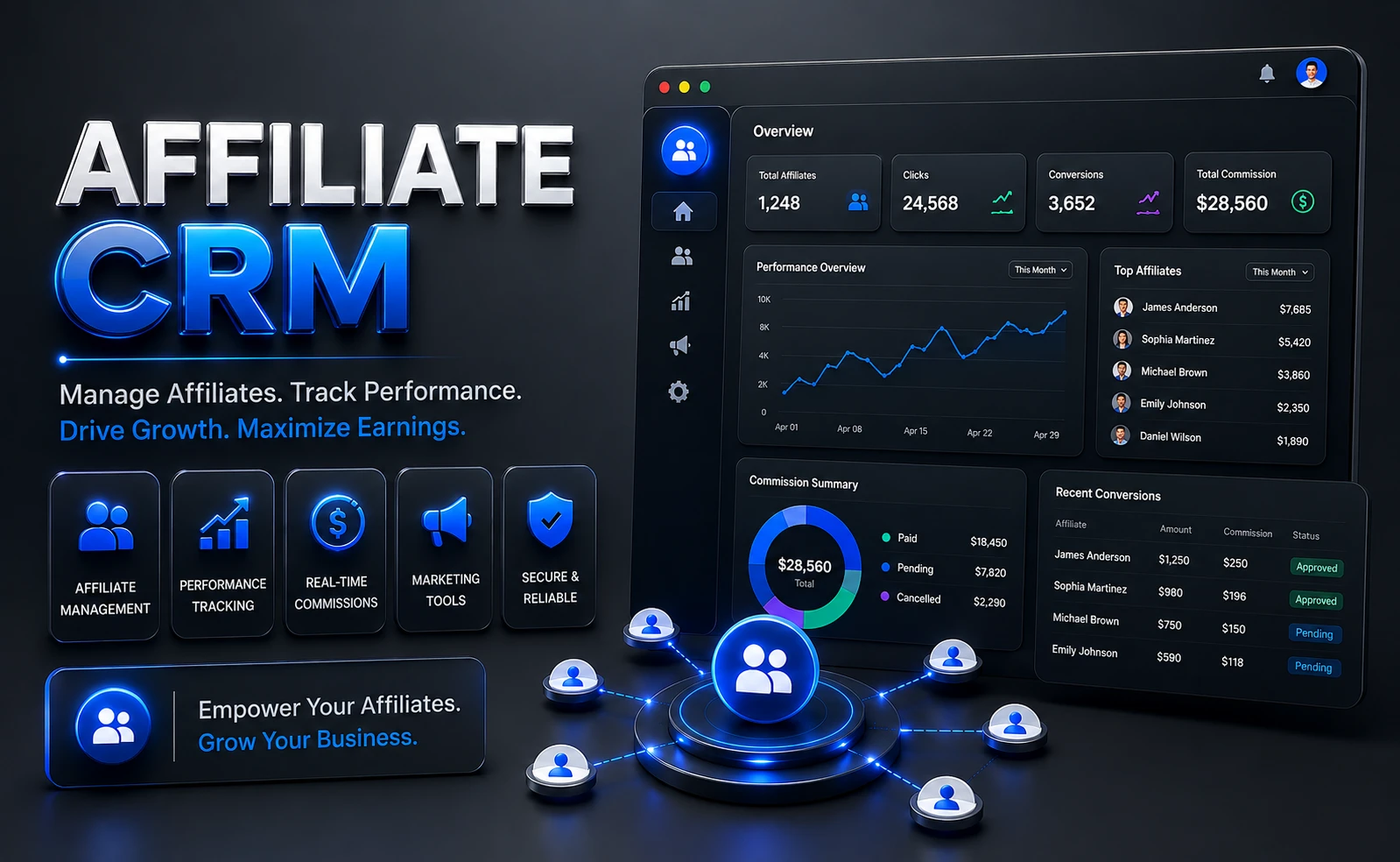
Managing a growing affiliate network requires far more than spreadsheets and manually calculated commissions. As the number of partners, referrals, campaigns, commission structures, and payouts increases, maintaining accurate attribution and transparent reporting becomes increasingly difficult. Our Affiliate CRM provides a centralized platform for managing the complete affiliate lifecycle—from partner onboarding and referral tracking to commission calculation, fraud monitoring, performance management, and payouts.
The platform gives businesses complete visibility across their affiliate network while providing affiliates with dedicated dashboards where they can monitor referrals, conversions, commissions, and earnings in real time. Automated tracking connects affiliate activity with customer registrations, transactions, purchases, deposits, or other defined conversion events, helping ensure that partners receive credit according to configured rules.
Multi-tier affiliate structures allow businesses to create relationships between primary affiliates, sub-affiliates, and additional partner levels. Flexible commission models support CPA, revenue share, hybrid, and performance-based arrangements, allowing the system to adapt to different business models instead of forcing every partner into the same compensation structure.
Built for transparency, accuracy, and scalability, the Affiliate CRM also provides fraud detection, approval workflows, configurable commission rules, multi-currency reporting, automated payout management, audit trails, and detailed performance analytics. Whether you are managing a small group of strategic partners or a large international affiliate network, the platform provides the infrastructure needed to grow partnerships without losing operational control.
Centralized Affiliate Management
The Affiliate CRM provides a single environment for managing the entire affiliate network.
Business teams can manage affiliate profiles, referral relationships, campaigns, commission plans, performance data, payout records, approvals, and partner activity from one centralized platform.
Affiliate Registration and Onboarding
New affiliates can register through a structured onboarding process designed around your business requirements.
The system can collect contact information, promotional details, payment preferences, required documentation, traffic sources, and other relevant information before an affiliate becomes active.
Affiliate Approval Workflows
Businesses can control which partners are approved before they receive access to affiliate tools and tracking links.
Custom approval workflows can route applications to the appropriate team members for review, verification, approval, rejection, or additional information requests.
Affiliate Profile Management
Each affiliate can have a dedicated profile containing their relevant partnership information.
Profiles can include referral performance, conversion statistics, commission plans, payout information, campaign participation, account status, and historical activity.
Referral Tracking
Accurate referral attribution is the foundation of every successful affiliate program.
The CRM can track referral activity through unique affiliate identifiers, tracking links, campaign parameters, or other configured attribution methods, connecting partner activity with the resulting customer journey.
Real-Time Conversion Tracking
Affiliate conversions can be recorded as they occur according to defined business events.
Depending on the business model, these events can include registrations, qualified leads, purchases, deposits, subscriptions, funded accounts, or other measurable actions.
Affiliate Link Management
Affiliates can receive unique tracking links that connect their promotional activity with the appropriate partner account.
Businesses can create, manage, deactivate, and organize links according to affiliates, campaigns, products, markets, or promotional channels.
Campaign Tracking
Multiple campaigns can be managed simultaneously within the CRM.
Businesses can create campaign-specific tracking structures to compare affiliate performance across products, promotions, landing pages, geographic markets, or acquisition initiatives.
Multi-Tier Affiliate Management
The platform supports affiliate structures that extend beyond a single referral level.
Businesses can create relationships between direct affiliates, sub-affiliates, and additional tiers, allowing partner networks to expand while maintaining structured attribution and compensation.
Automated Sub-Affiliate Compensation
When an affiliate network includes multiple levels, compensation can be calculated automatically according to predefined rules.
This allows eligible partners at different levels to receive their configured commissions without requiring manual calculations for every transaction.
Flexible Commission Models
Different affiliates may require different compensation arrangements.
The Affiliate CRM can support multiple commission models so businesses can design programs around their actual commercial strategy.
CPA Commission Structures
Cost-per-acquisition models can reward affiliates when predefined conversion conditions are met.
Businesses can configure CPA rules around selected customer actions, products, markets, or account types.
Revenue Share Models
Revenue-sharing programs can calculate affiliate compensation according to eligible revenue generated through referred customers.
This allows affiliates to participate in ongoing customer value rather than receiving only a fixed acquisition payment.
Hybrid Commission Models
Businesses can combine different compensation methods within a single affiliate strategy.
Hybrid structures can incorporate CPA, revenue share, bonuses, volume incentives, or other configured rules where appropriate.
Performance-Based Commissions
Commission rates can be linked to affiliate performance.
Higher-performing partners can qualify for improved rates, additional incentives, or different commission tiers based on predefined requirements.
Affiliate Tier Management
The platform can organize affiliates into different performance tiers.
Tier requirements can be based on conversions, revenue, referred customers, trading volume, sales, or other measurable performance indicators.
Automated Tier Upgrades
The system can monitor affiliate performance and automatically identify when an affiliate qualifies for a higher tier.
This reduces manual administration and provides affiliates with a clearer path toward improved earning potential.
Tier Downgrade and Review Rules
Businesses can also configure rules around maintaining affiliate status or performance levels.
This helps ensure that partner tiers remain aligned with current performance rather than being based only on historical achievements.
Real-Time Affiliate Dashboards
Affiliates receive a dedicated dashboard where they can monitor their own performance.
Depending on configured permissions, dashboards can display clicks, registrations, conversions, qualified customers, commission earnings, payout balances, and campaign performance.
Affiliate Earnings Visibility
Partners can see how their commissions are developing without repeatedly contacting the business.
Clear earnings information can include pending commissions, approved commissions, paid commissions, adjustments, and historical earnings.
Conversion Analytics
Affiliate dashboards can provide insight into the customer journey from referral through conversion.
This helps partners understand which campaigns and promotional activities are generating meaningful results.
Performance Reporting
Businesses can analyze affiliate performance across the entire network.
Reports can compare partners based on traffic, conversions, revenue contribution, commission costs, customer quality, retention, or other configured metrics.
Top Affiliate Identification
Management dashboards can highlight the strongest-performing partners.
This allows teams to identify affiliates that consistently generate high-quality customers and prioritize strategic relationship management.
Underperforming Affiliate Monitoring
The CRM can also identify declining or inactive partner accounts.
Businesses can use these insights to evaluate whether additional support, campaign changes, revised incentives, or partner engagement may be appropriate.
Multi-Currency Affiliate Management
International affiliate networks often operate across multiple currencies.
The platform can support multi-currency commission reporting and payout workflows according to the business's configured financial requirements.
Currency-Specific Commission Rules
Commission plans can be structured around different currencies where necessary.
This provides greater flexibility for businesses operating across multiple regions and markets.
Multi-Currency Payouts
Approved affiliate earnings can be processed through configured payout workflows using supported currencies and payment methods.
This creates a more convenient experience for international partners while giving finance teams centralized visibility.
Automated Payout Management
Affiliate payouts can be managed through structured workflows rather than disconnected spreadsheets.
The system can track payout eligibility, approval status, payment processing, completed payments, rejected requests, and historical payout records.
Payout Approval Workflows
Businesses can introduce internal approval steps before commissions are paid.
This provides greater financial control and ensures that payouts are reviewed according to internal policies.
Affiliate Withdrawal Requests
Where enabled, affiliates can submit withdrawal or payout requests directly through their portal.
Requests can then move through the configured review and payment workflow.
Payout Status Tracking
Affiliates can monitor the status of their payout requests.
Statuses such as pending, approved, processing, completed, rejected, or cancelled can provide greater transparency throughout the payment lifecycle.
Automated Commission Calculations
Manual commission calculations become increasingly risky as affiliate networks grow.
The CRM automatically applies configured commission rules to eligible conversions, reducing repetitive calculations and improving consistency.
Commission Statements
Affiliates can receive detailed commission statements showing relevant conversion activity and resulting earnings.
This gives partners a clearer understanding of how their commissions were generated.
Commission History
Historical commission records can be maintained for each affiliate.
Authorized users can review previous earning periods, adjustments, payout records, and calculation information when investigating historical activity.
Commission Adjustments
Authorized business users can make controlled adjustments when corrections are required.
Each adjustment can be documented with the relevant reason and historical record to maintain transparency.
Fraud Detection
Large affiliate programs can attract suspicious traffic, duplicate registrations, incentivized abuse, or other questionable referral behavior.
The CRM can monitor configured indicators and flag unusual patterns for review before they create significant financial or operational problems.
Suspicious Referral Pattern Detection
Referral behavior can be analyzed for patterns that differ significantly from expected activity.
Potential indicators may include unusual conversion rates, repeated customer attributes, abnormal traffic behavior, duplicate activity, or other configured risk signals.
Duplicate Referral Detection
The system can help identify duplicate or conflicting referral relationships.
This reduces the risk of multiple affiliates attempting to claim credit for the same customer or conversion.
Traffic Quality Monitoring
Affiliate traffic can be monitored using configurable quality indicators.
Businesses can compare traffic sources, conversion patterns, customer activity, and other available metrics to identify unusual or low-quality acquisition behavior.
Fraud Review Workflows
Flagged activity can be routed into structured review workflows.
Authorized teams can investigate the relevant affiliate, referral, campaign, and conversion information before making a decision.
Affiliate Suspension Controls
Businesses can temporarily restrict affiliate activity when a review is required.
This can help prevent additional questionable referrals or payouts from being processed while an investigation is underway.
Fraud Audit Trails
Important fraud-related actions can be recorded for future review.
This provides a documented history of flagged activity, investigation decisions, account actions, and related administrative changes.
Affiliate Compliance Management
Affiliate marketing can involve specific advertising, disclosure, traffic-source, and promotional requirements.
The CRM can support internal compliance workflows, partner approvals, documentation, and activity monitoring according to the business's operating requirements.
Promotional Asset Management
Affiliates can access approved promotional materials through their partner environment.
Businesses can organize banners, landing pages, tracking links, promotional copy, campaign information, and other marketing assets.
Affiliate Marketing Materials
Centralizing approved marketing assets helps ensure partners have access to current materials.
This can reduce reliance on outdated documents and disconnected communication channels.
Landing Page Integration
Affiliate links can connect directly with dedicated landing pages designed for specific campaigns.
This creates a more controlled customer acquisition journey while allowing businesses to measure campaign performance.
Lead Tracking
For businesses using lead-generation affiliate models, the CRM can track referred leads through defined stages.
This can help connect affiliate activity with lead qualification, sales progression, or other downstream conversion events.
Customer Attribution
The system can maintain the relationship between affiliates and the customers they referred.
This creates a reliable attribution layer for calculating commissions and measuring long-term partner performance.
Customer Lifecycle Tracking
Affiliate performance can be evaluated beyond the initial conversion.
Where integrated with the relevant business systems, the CRM can help monitor customer activity, retention, repeat transactions, or other lifecycle metrics.
Affiliate ROI Analysis
Businesses can compare affiliate-generated value against commissions and acquisition costs.
This provides management with greater visibility into the commercial performance of different partners and campaigns.
Commission Cost Analysis
Affiliate commissions can represent a significant operating expense.
The CRM can provide reporting that helps businesses understand commission costs relative to conversions, revenue, customer value, or other selected KPIs.
Affiliate Campaign Analytics
Campaign-level reporting can reveal which promotional initiatives produce the strongest results.
Businesses can compare affiliates, traffic sources, products, geographic markets, and campaign periods to identify growth opportunities.
Geographic Affiliate Management
International businesses can organize affiliate programs across countries and regions.
Geographic reporting can help management understand where partners are generating traffic, leads, conversions, and revenue.
Product-Level Affiliate Tracking
Affiliate performance can be analyzed across individual products or services.
This allows businesses to identify which offerings are most effectively promoted by their partner network.
Affiliate API Integration
The CRM can connect with external systems through APIs where required.
This makes it possible to integrate affiliate management with websites, e-commerce platforms, CRMs, payment systems, trading platforms, subscription systems, analytics platforms, and other business applications.
CRM Integration
Affiliate information can be synchronized with the organization's broader CRM infrastructure.
This creates stronger coordination between affiliate acquisition, sales, customer management, onboarding, and retention teams.
Payment Integration
Affiliate payout processes can be connected with supported payment infrastructure.
This can help streamline approved commission payments while keeping transaction records centralized.
E-Commerce Integration
For e-commerce businesses, affiliate tracking can be connected with orders and customer transactions.
This allows affiliate commissions to be calculated against eligible purchases according to configured rules.
Subscription and SaaS Integration
Subscription-based businesses can connect affiliate attribution with recurring customer activity.
This can support revenue-share models where partner compensation depends on ongoing subscription revenue.
Trading and Financial Platform Integration
For brokers, prop firms, fintech companies, and trading platforms, affiliate attribution can be connected with relevant account and transaction systems.
This allows commission calculations to be based on approved customer activity such as registrations, deposits, account activation, or other defined events.
Role-Based Access Control
Different teams require different levels of access to affiliate information.
Administrators, finance teams, marketing managers, compliance teams, support staff, and affiliates can receive permissions appropriate to their responsibilities.
Affiliate Data Protection
Affiliates should only have access to information relevant to their own partnership activity.
Permission-based access can prevent unnecessary exposure of confidential customer, financial, or operational information.
Automated Notifications
The CRM can send notifications for important affiliate events.
These may include new registrations, commission updates, tier changes, payout approvals, rejected transactions, campaign updates, fraud flags, or other configured events.
Affiliate Communication
Businesses can communicate important program information directly through the affiliate environment.
Notifications and structured messaging can help reduce repetitive email exchanges and ensure partners receive relevant updates.
Affiliate Resource Center
The platform can provide affiliates with access to program information, commission rules, marketing resources, FAQs, campaign instructions, and other approved materials.
This creates a more self-service partner experience.
Audit Trails
Important actions across the affiliate lifecycle can be recorded through detailed audit trails.
This can include commission rule changes, affiliate approvals, payout decisions, adjustments, account status changes, fraud reviews, and other administrative activities.
Commission Calculation Auditability
When a partner questions a commission, authorized users can review the underlying conversion and calculation information.
This makes commission discussions easier to investigate and helps create a more transparent partner relationship.
Dispute Management
Affiliate commission disputes can be managed through structured workflows rather than informal conversations.
Disputes can be associated with specific conversions, transactions, commission periods, campaigns, or payout records.
Dispute Resolution
Authorized teams can review disputed activity, add internal notes, evaluate supporting information, and document the final resolution.
This creates a consistent process for handling partner disagreements.
Automated Reporting
Scheduled reports can provide regular visibility into affiliate network performance.
Reports can cover conversions, commissions, payouts, traffic, revenue, affiliate rankings, fraud indicators, and other relevant metrics.
Management Analytics
Leadership teams can access high-level performance information across the entire affiliate network.
This can help identify trends, evaluate partner acquisition costs, and make informed decisions about commission strategies and affiliate investment.
Affiliate Retention Monitoring
A healthy affiliate program depends on keeping valuable partners engaged.
Performance trends can help identify partners whose activity is increasing, declining, or becoming inactive over time.
Partner Incentive Programs
The platform can support performance-based incentives designed to encourage affiliate growth.
Businesses can create structured rewards around conversion targets, revenue milestones, customer acquisition, or other approved metrics.
Affiliate Bonus Programs
Additional bonuses can be configured for specific campaigns or performance periods.
This gives businesses greater flexibility when launching seasonal promotions, product launches, or strategic acquisition initiatives.
Scalable Affiliate Infrastructure
The platform is designed to support growth from a small group of partners to large international affiliate networks.
As the number of affiliates, referrals, conversions, commission records, campaigns, and payouts increases, the system can provide centralized management without relying on increasingly complex spreadsheets.
Centralized Affiliate Administration
Management teams can control partner onboarding, commission structures, campaigns, fraud reviews, performance tiers, payout workflows, and reporting from one administrative environment.
This creates a more efficient operating model for growing partnership teams.
Reduce Manual Administration
Automating referral attribution, commission calculations, tier management, reporting, and payout workflows reduces repetitive administrative work.
Teams can focus more on developing valuable partnerships and less on maintaining spreadsheets and manually reconciling partner data.
Build a More Transparent Affiliate Program
Trust is essential to long-term affiliate relationships.
When affiliates can see their referral performance, conversions, commissions, and payout status through a dedicated dashboard, the partnership becomes easier to understand and manage.
Protect Affiliate Program Economics
Fraud monitoring, configurable commission rules, approval workflows, and detailed reporting help businesses maintain better control over affiliate acquisition costs.
This creates a stronger foundation for scaling partner acquisition without losing visibility into program economics.
Turn Partnerships Into a Scalable Growth Channel
An affiliate program should make growth easier—not create a new layer of administrative complexity.
Our Affiliate CRM provides the infrastructure required to manage affiliates, referrals, campaigns, multi-tier relationships, commissions, fraud monitoring, performance incentives, and payouts from one centralized platform.
From the moment an affiliate joins the program to the moment a commission is calculated and paid, the complete partner lifecycle can be connected through structured workflows, real-time reporting, and configurable business rules.
Manage your entire affiliate network from one platform. Track every referral, automate commissions, support multi-tier partnerships, detect suspicious activity, reward top performers, simplify payouts, and maintain complete transparency—creating an Affiliate CRM built for accurate, scalable, and sustainable partnership-driven growth.
Product description
Learn more about product features and benefits
Affiliate CRM
Managing a growing affiliate network requires far more than spreadsheets and manually calculated commissions. As the number of partners, referrals, campaigns, commission structures, and payouts increases, maintaining accurate attribution and transparent reporting becomes increasingly difficult. Our Affiliate CRM provides a centralized platform for managing the complete affiliate lifecycle—from partner onboarding and referral tracking to commission calculation, fraud monitoring, performance management, and payouts.
The platform gives businesses complete visibility across their affiliate network while providing affiliates with dedicated dashboards where they can monitor referrals, conversions, commissions, and earnings in real time. Automated tracking connects affiliate activity with customer registrations, transactions, purchases, deposits, or other defined conversion events, helping ensure that partners receive credit according to configured rules.
Multi-tier affiliate structures allow businesses to create relationships between primary affiliates, sub-affiliates, and additional partner levels. Flexible commission models support CPA, revenue share, hybrid, and performance-based arrangements, allowing the system to adapt to different business models instead of forcing every partner into the same compensation structure.
Built for transparency, accuracy, and scalability, the Affiliate CRM also provides fraud detection, approval workflows, configurable commission rules, multi-currency reporting, automated payout management, audit trails, and detailed performance analytics. Whether you are managing a small group of strategic partners or a large international affiliate network, the platform provides the infrastructure needed to grow partnerships without losing operational control.
Centralized Affiliate Management
The Affiliate CRM provides a single environment for managing the entire affiliate network.
Business teams can manage affiliate profiles, referral relationships, campaigns, commission plans, performance data, payout records, approvals, and partner activity from one centralized platform.
Affiliate Registration and Onboarding
New affiliates can register through a structured onboarding process designed around your business requirements.
The system can collect contact information, promotional details, payment preferences, required documentation, traffic sources, and other relevant information before an affiliate becomes active.
Affiliate Approval Workflows
Businesses can control which partners are approved before they receive access to affiliate tools and tracking links.
Custom approval workflows can route applications to the appropriate team members for review, verification, approval, rejection, or additional information requests.
Affiliate Profile Management
Each affiliate can have a dedicated profile containing their relevant partnership information.
Profiles can include referral performance, conversion statistics, commission plans, payout information, campaign participation, account status, and historical activity.
Referral Tracking
Accurate referral attribution is the foundation of every successful affiliate program.
The CRM can track referral activity through unique affiliate identifiers, tracking links, campaign parameters, or other configured attribution methods, connecting partner activity with the resulting customer journey.
Real-Time Conversion Tracking
Affiliate conversions can be recorded as they occur according to defined business events.
Depending on the business model, these events can include registrations, qualified leads, purchases, deposits, subscriptions, funded accounts, or other measurable actions.
Affiliate Link Management
Affiliates can receive unique tracking links that connect their promotional activity with the appropriate partner account.
Businesses can create, manage, deactivate, and organize links according to affiliates, campaigns, products, markets, or promotional channels.
Campaign Tracking
Multiple campaigns can be managed simultaneously within the CRM.
Businesses can create campaign-specific tracking structures to compare affiliate performance across products, promotions, landing pages, geographic markets, or acquisition initiatives.
Multi-Tier Affiliate Management
The platform supports affiliate structures that extend beyond a single referral level.
Businesses can create relationships between direct affiliates, sub-affiliates, and additional tiers, allowing partner networks to expand while maintaining structured attribution and compensation.
Automated Sub-Affiliate Compensation
When an affiliate network includes multiple levels, compensation can be calculated automatically according to predefined rules.
This allows eligible partners at different levels to receive their configured commissions without requiring manual calculations for every transaction.
Flexible Commission Models
Different affiliates may require different compensation arrangements.
The Affiliate CRM can support multiple commission models so businesses can design programs around their actual commercial strategy.
CPA Commission Structures
Cost-per-acquisition models can reward affiliates when predefined conversion conditions are met.
Businesses can configure CPA rules around selected customer actions, products, markets, or account types.
Revenue Share Models
Revenue-sharing programs can calculate affiliate compensation according to eligible revenue generated through referred customers.
This allows affiliates to participate in ongoing customer value rather than receiving only a fixed acquisition payment.
Hybrid Commission Models
Businesses can combine different compensation methods within a single affiliate strategy.
Hybrid structures can incorporate CPA, revenue share, bonuses, volume incentives, or other configured rules where appropriate.
Performance-Based Commissions
Commission rates can be linked to affiliate performance.
Higher-performing partners can qualify for improved rates, additional incentives, or different commission tiers based on predefined requirements.
Affiliate Tier Management
The platform can organize affiliates into different performance tiers.
Tier requirements can be based on conversions, revenue, referred customers, trading volume, sales, or other measurable performance indicators.
Automated Tier Upgrades
The system can monitor affiliate performance and automatically identify when an affiliate qualifies for a higher tier.
This reduces manual administration and provides affiliates with a clearer path toward improved earning potential.
Tier Downgrade and Review Rules
Businesses can also configure rules around maintaining affiliate status or performance levels.
This helps ensure that partner tiers remain aligned with current performance rather than being based only on historical achievements.
Real-Time Affiliate Dashboards
Affiliates receive a dedicated dashboard where they can monitor their own performance.
Depending on configured permissions, dashboards can display clicks, registrations, conversions, qualified customers, commission earnings, payout balances, and campaign performance.
Affiliate Earnings Visibility
Partners can see how their commissions are developing without repeatedly contacting the business.
Clear earnings information can include pending commissions, approved commissions, paid commissions, adjustments, and historical earnings.
Conversion Analytics
Affiliate dashboards can provide insight into the customer journey from referral through conversion.
This helps partners understand which campaigns and promotional activities are generating meaningful results.
Performance Reporting
Businesses can analyze affiliate performance across the entire network.
Reports can compare partners based on traffic, conversions, revenue contribution, commission costs, customer quality, retention, or other configured metrics.
Top Affiliate Identification
Management dashboards can highlight the strongest-performing partners.
This allows teams to identify affiliates that consistently generate high-quality customers and prioritize strategic relationship management.
Underperforming Affiliate Monitoring
The CRM can also identify declining or inactive partner accounts.
Businesses can use these insights to evaluate whether additional support, campaign changes, revised incentives, or partner engagement may be appropriate.
Multi-Currency Affiliate Management
International affiliate networks often operate across multiple currencies.
The platform can support multi-currency commission reporting and payout workflows according to the business's configured financial requirements.
Currency-Specific Commission Rules
Commission plans can be structured around different currencies where necessary.
This provides greater flexibility for businesses operating across multiple regions and markets.
Multi-Currency Payouts
Approved affiliate earnings can be processed through configured payout workflows using supported currencies and payment methods.
This creates a more convenient experience for international partners while giving finance teams centralized visibility.
Automated Payout Management
Affiliate payouts can be managed through structured workflows rather than disconnected spreadsheets.
The system can track payout eligibility, approval status, payment processing, completed payments, rejected requests, and historical payout records.
Payout Approval Workflows
Businesses can introduce internal approval steps before commissions are paid.
This provides greater financial control and ensures that payouts are reviewed according to internal policies.
Affiliate Withdrawal Requests
Where enabled, affiliates can submit withdrawal or payout requests directly through their portal.
Requests can then move through the configured review and payment workflow.
Payout Status Tracking
Affiliates can monitor the status of their payout requests.
Statuses such as pending, approved, processing, completed, rejected, or cancelled can provide greater transparency throughout the payment lifecycle.
Automated Commission Calculations
Manual commission calculations become increasingly risky as affiliate networks grow.
The CRM automatically applies configured commission rules to eligible conversions, reducing repetitive calculations and improving consistency.
Commission Statements
Affiliates can receive detailed commission statements showing relevant conversion activity and resulting earnings.
This gives partners a clearer understanding of how their commissions were generated.
Commission History
Historical commission records can be maintained for each affiliate.
Authorized users can review previous earning periods, adjustments, payout records, and calculation information when investigating historical activity.
Commission Adjustments
Authorized business users can make controlled adjustments when corrections are required.
Each adjustment can be documented with the relevant reason and historical record to maintain transparency.
Fraud Detection
Large affiliate programs can attract suspicious traffic, duplicate registrations, incentivized abuse, or other questionable referral behavior.
The CRM can monitor configured indicators and flag unusual patterns for review before they create significant financial or operational problems.
Suspicious Referral Pattern Detection
Referral behavior can be analyzed for patterns that differ significantly from expected activity.
Potential indicators may include unusual conversion rates, repeated customer attributes, abnormal traffic behavior, duplicate activity, or other configured risk signals.
Duplicate Referral Detection
The system can help identify duplicate or conflicting referral relationships.
This reduces the risk of multiple affiliates attempting to claim credit for the same customer or conversion.
Traffic Quality Monitoring
Affiliate traffic can be monitored using configurable quality indicators.
Businesses can compare traffic sources, conversion patterns, customer activity, and other available metrics to identify unusual or low-quality acquisition behavior.
Fraud Review Workflows
Flagged activity can be routed into structured review workflows.
Authorized teams can investigate the relevant affiliate, referral, campaign, and conversion information before making a decision.
Affiliate Suspension Controls
Businesses can temporarily restrict affiliate activity when a review is required.
This can help prevent additional questionable referrals or payouts from being processed while an investigation is underway.
Fraud Audit Trails
Important fraud-related actions can be recorded for future review.
This provides a documented history of flagged activity, investigation decisions, account actions, and related administrative changes.
Affiliate Compliance Management
Affiliate marketing can involve specific advertising, disclosure, traffic-source, and promotional requirements.
The CRM can support internal compliance workflows, partner approvals, documentation, and activity monitoring according to the business's operating requirements.
Promotional Asset Management
Affiliates can access approved promotional materials through their partner environment.
Businesses can organize banners, landing pages, tracking links, promotional copy, campaign information, and other marketing assets.
Affiliate Marketing Materials
Centralizing approved marketing assets helps ensure partners have access to current materials.
This can reduce reliance on outdated documents and disconnected communication channels.
Landing Page Integration
Affiliate links can connect directly with dedicated landing pages designed for specific campaigns.
This creates a more controlled customer acquisition journey while allowing businesses to measure campaign performance.
Lead Tracking
For businesses using lead-generation affiliate models, the CRM can track referred leads through defined stages.
This can help connect affiliate activity with lead qualification, sales progression, or other downstream conversion events.
Customer Attribution
The system can maintain the relationship between affiliates and the customers they referred.
This creates a reliable attribution layer for calculating commissions and measuring long-term partner performance.
Customer Lifecycle Tracking
Affiliate performance can be evaluated beyond the initial conversion.
Where integrated with the relevant business systems, the CRM can help monitor customer activity, retention, repeat transactions, or other lifecycle metrics.
Affiliate ROI Analysis
Businesses can compare affiliate-generated value against commissions and acquisition costs.
This provides management with greater visibility into the commercial performance of different partners and campaigns.
Commission Cost Analysis
Affiliate commissions can represent a significant operating expense.
The CRM can provide reporting that helps businesses understand commission costs relative to conversions, revenue, customer value, or other selected KPIs.
Affiliate Campaign Analytics
Campaign-level reporting can reveal which promotional initiatives produce the strongest results.
Businesses can compare affiliates, traffic sources, products, geographic markets, and campaign periods to identify growth opportunities.
Geographic Affiliate Management
International businesses can organize affiliate programs across countries and regions.
Geographic reporting can help management understand where partners are generating traffic, leads, conversions, and revenue.
Product-Level Affiliate Tracking
Affiliate performance can be analyzed across individual products or services.
This allows businesses to identify which offerings are most effectively promoted by their partner network.
Affiliate API Integration
The CRM can connect with external systems through APIs where required.
This makes it possible to integrate affiliate management with websites, e-commerce platforms, CRMs, payment systems, trading platforms, subscription systems, analytics platforms, and other business applications.
CRM Integration
Affiliate information can be synchronized with the organization's broader CRM infrastructure.
This creates stronger coordination between affiliate acquisition, sales, customer management, onboarding, and retention teams.
Payment Integration
Affiliate payout processes can be connected with supported payment infrastructure.
This can help streamline approved commission payments while keeping transaction records centralized.
E-Commerce Integration
For e-commerce businesses, affiliate tracking can be connected with orders and customer transactions.
This allows affiliate commissions to be calculated against eligible purchases according to configured rules.
Subscription and SaaS Integration
Subscription-based businesses can connect affiliate attribution with recurring customer activity.
This can support revenue-share models where partner compensation depends on ongoing subscription revenue.
Trading and Financial Platform Integration
For brokers, prop firms, fintech companies, and trading platforms, affiliate attribution can be connected with relevant account and transaction systems.
This allows commission calculations to be based on approved customer activity such as registrations, deposits, account activation, or other defined events.
Role-Based Access Control
Different teams require different levels of access to affiliate information.
Administrators, finance teams, marketing managers, compliance teams, support staff, and affiliates can receive permissions appropriate to their responsibilities.
Affiliate Data Protection
Affiliates should only have access to information relevant to their own partnership activity.
Permission-based access can prevent unnecessary exposure of confidential customer, financial, or operational information.
Automated Notifications
The CRM can send notifications for important affiliate events.
These may include new registrations, commission updates, tier changes, payout approvals, rejected transactions, campaign updates, fraud flags, or other configured events.
Affiliate Communication
Businesses can communicate important program information directly through the affiliate environment.
Notifications and structured messaging can help reduce repetitive email exchanges and ensure partners receive relevant updates.
Affiliate Resource Center
The platform can provide affiliates with access to program information, commission rules, marketing resources, FAQs, campaign instructions, and other approved materials.
This creates a more self-service partner experience.
Audit Trails
Important actions across the affiliate lifecycle can be recorded through detailed audit trails.
This can include commission rule changes, affiliate approvals, payout decisions, adjustments, account status changes, fraud reviews, and other administrative activities.
Commission Calculation Auditability
When a partner questions a commission, authorized users can review the underlying conversion and calculation information.
This makes commission discussions easier to investigate and helps create a more transparent partner relationship.
Dispute Management
Affiliate commission disputes can be managed through structured workflows rather than informal conversations.
Disputes can be associated with specific conversions, transactions, commission periods, campaigns, or payout records.
Dispute Resolution
Authorized teams can review disputed activity, add internal notes, evaluate supporting information, and document the final resolution.
This creates a consistent process for handling partner disagreements.
Automated Reporting
Scheduled reports can provide regular visibility into affiliate network performance.
Reports can cover conversions, commissions, payouts, traffic, revenue, affiliate rankings, fraud indicators, and other relevant metrics.
Management Analytics
Leadership teams can access high-level performance information across the entire affiliate network.
This can help identify trends, evaluate partner acquisition costs, and make informed decisions about commission strategies and affiliate investment.
Affiliate Retention Monitoring
A healthy affiliate program depends on keeping valuable partners engaged.
Performance trends can help identify partners whose activity is increasing, declining, or becoming inactive over time.
Partner Incentive Programs
The platform can support performance-based incentives designed to encourage affiliate growth.
Businesses can create structured rewards around conversion targets, revenue milestones, customer acquisition, or other approved metrics.
Affiliate Bonus Programs
Additional bonuses can be configured for specific campaigns or performance periods.
This gives businesses greater flexibility when launching seasonal promotions, product launches, or strategic acquisition initiatives.
Scalable Affiliate Infrastructure
The platform is designed to support growth from a small group of partners to large international affiliate networks.
As the number of affiliates, referrals, conversions, commission records, campaigns, and payouts increases, the system can provide centralized management without relying on increasingly complex spreadsheets.
Centralized Affiliate Administration
Management teams can control partner onboarding, commission structures, campaigns, fraud reviews, performance tiers, payout workflows, and reporting from one administrative environment.
This creates a more efficient operating model for growing partnership teams.
Reduce Manual Administration
Automating referral attribution, commission calculations, tier management, reporting, and payout workflows reduces repetitive administrative work.
Teams can focus more on developing valuable partnerships and less on maintaining spreadsheets and manually reconciling partner data.
Build a More Transparent Affiliate Program
Trust is essential to long-term affiliate relationships.
When affiliates can see their referral performance, conversions, commissions, and payout status through a dedicated dashboard, the partnership becomes easier to understand and manage.
Protect Affiliate Program Economics
Fraud monitoring, configurable commission rules, approval workflows, and detailed reporting help businesses maintain better control over affiliate acquisition costs.
This creates a stronger foundation for scaling partner acquisition without losing visibility into program economics.
Turn Partnerships Into a Scalable Growth Channel
An affiliate program should make growth easier—not create a new layer of administrative complexity.
Our Affiliate CRM provides the infrastructure required to manage affiliates, referrals, campaigns, multi-tier relationships, commissions, fraud monitoring, performance incentives, and payouts from one centralized platform.
From the moment an affiliate joins the program to the moment a commission is calculated and paid, the complete partner lifecycle can be connected through structured workflows, real-time reporting, and configurable business rules.
Manage your entire affiliate network from one platform. Track every referral, automate commissions, support multi-tier partnerships, detect suspicious activity, reward top performers, simplify payouts, and maintain complete transparency—creating an Affiliate CRM built for accurate, scalable, and sustainable partnership-driven growth.
Product specification
Quick product information

No review given yet!