العربية
 English
 हिन्दी
 Malay
Malay اُردُو
 বাংলা
বাংলা Français
 Português
 Italiano
 Nederlands
 Deutsch
 Русский
 Español
 中文
中文 ไทย
ไทย Türkçe
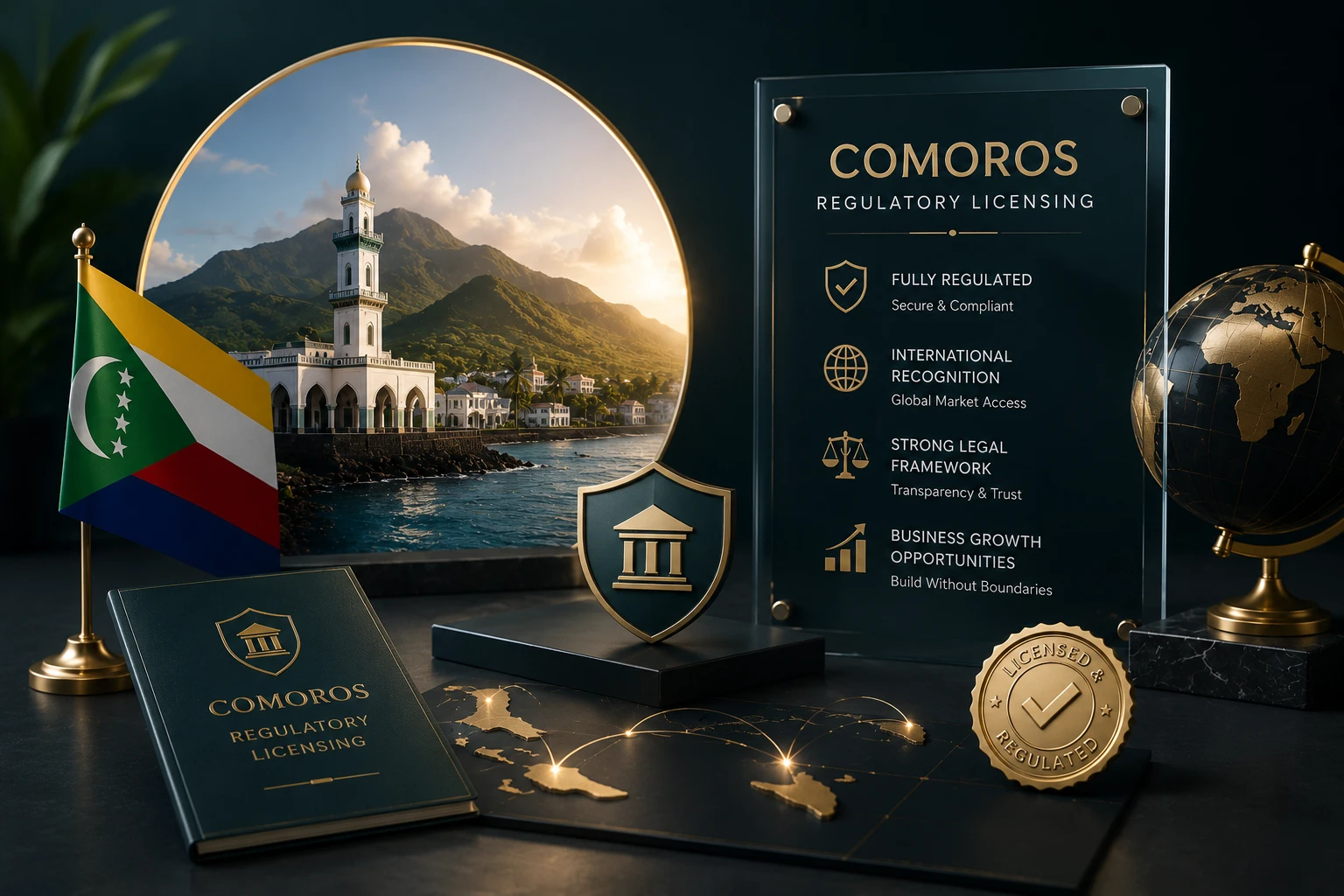
Comoros Regulatory Licensing

Added By BridgingFX
Product overview
Everything you need to know about this product
Comoros Regulatory Licensing
For new and growing forex businesses, choosing an appropriate regulatory jurisdiction is an important strategic decision. Comoros Regulatory Licensing provides structured support for businesses evaluating a regulatory pathway in the Union of the Comoros, helping coordinate the licensing process from initial assessment and documentation through local-agent coordination, application submission, regulatory communication, and ongoing compliance support.
Establishing a regulated financial business requires more than obtaining a certificate or completing an application form. Corporate structure, ownership information, management details, business plans, compliance documentation, operational procedures, and regulatory correspondence all need to be handled carefully and consistently.
Our service is designed to simplify that process for businesses that want a clearly organized route into their target market. We coordinate the relevant documentation, work with appropriate local representatives where required, and help businesses understand the practical responsibilities associated with maintaining their regulatory status.
End-to-End Comoros Licensing Support
A licensing application can involve numerous documents, approvals, local contacts, and regulatory interactions.
Our end-to-end approach brings these activities into one coordinated process, helping businesses move from initial planning to application preparation, submission, regulatory follow-up, and post-licensing support.
Jurisdiction Assessment
Before pursuing any regulatory license, businesses should understand whether the jurisdiction is appropriate for their intended activities.
We review the proposed business model, target markets, products, ownership structure, operational requirements, and regulatory objectives to help determine whether the Comoros route fits the company's wider strategy.
Business Activity Assessment
The regulatory requirements can depend on the exact nature of the business.
We help clarify the proposed activities and organize the licensing strategy around the relevant business model rather than applying a generic approach.
Corporate Structure Planning
A suitable corporate structure provides the foundation for the licensing application.
We help coordinate the relevant company structure, ownership information, management details, corporate documentation, and other requirements applicable to the proposed operation.
Entity Formation Support
Where required, we assist with the coordination of entity formation and related documentation.
This creates a structured corporate foundation for the licensing process and future business operations.
Ownership and Shareholder Documentation
Regulatory applications may require detailed information about shareholders, beneficial owners, directors, and other key individuals.
We help organize this information and supporting documentation so that the ownership structure is clearly presented.
Local Agent Coordination
Local representation can be an important component of jurisdiction-specific licensing processes.
We coordinate with appropriate registered local agents and relevant professional contacts where required, helping maintain communication and document flow throughout the application.
Regulatory Application Preparation
A complete application requires more than basic corporate documents.
We coordinate the preparation of business information, corporate records, management details, compliance documentation, operational information, financial materials, and other supporting requirements relevant to the application.
Document Review and Alignment
Inconsistent or incomplete documentation can create unnecessary questions and delays.
We review the application package for completeness and consistency, helping ensure that information across corporate records, business plans, policies, and supporting documents presents a coherent picture of the proposed business.
Business Plan Preparation
A clear business plan helps explain how the proposed company intends to operate.
The plan can cover business objectives, services, target markets, customer profiles, revenue model, organizational structure, staffing, technology infrastructure, risk management, compliance, and financial projections.
Compliance Policy Development
Regulatory preparation should be supported by practical compliance procedures.
We help organize policies relevant to areas such as customer due diligence, AML controls, risk management, internal procedures, record keeping, transaction monitoring, reporting, and compliance oversight, subject to the applicable requirements.
AML and KYC Framework
Customer identification and due diligence are important elements of responsible financial operations.
We help businesses establish documentation and workflows covering customer identification, risk classification, due diligence, enhanced due diligence where applicable, transaction monitoring principles, escalation procedures, and record retention.
Risk Management Framework
A structured risk framework helps businesses identify and respond to operational and financial risks.
We support the development of documentation addressing relevant business, customer, market, operational, technology, compliance, and other risks based on the company's actual operating model.
Internal Controls
Appropriate internal controls help establish accountability and reduce operational weaknesses.
The licensing preparation process can include documentation covering approvals, responsibilities, segregation of duties, transaction controls, compliance oversight, and escalation procedures.
Operational Infrastructure
A regulatory license should be supported by practical business infrastructure.
Depending on the business model, this can include CRM systems, customer portals, KYC technology, trading platforms, payment infrastructure, reporting tools, risk-management systems, communication channels, and administrative workflows.
Brokerage Infrastructure Planning
Forex brokers require multiple connected systems to operate efficiently.
We help businesses consider how their regulatory structure aligns with their intended trading platform, CRM, liquidity, payment, KYC, risk-management, and customer-support infrastructure.
Technology Integration Considerations
Modern brokerage operations are technology-driven.
Where relevant, the licensing and operational planning process can account for APIs, trading-platform integrations, customer-management systems, payment providers, reporting systems, and other technology required to support the proposed business.
Regulatory Correspondence
Regulatory communication can become one of the most challenging aspects of an application.
We coordinate relevant communications and help organize responses to questions, clarification requests, additional documentation requirements, and other matters raised during the review process.
Application Query Management
Additional questions may arise after an application is submitted.
We help structure responses so that explanations and supporting documents remain consistent with the information already provided.
Regulatory Follow-Up
Regular follow-up helps identify outstanding requirements and keep the application organized.
We coordinate relevant communication with local representatives and regulatory contacts throughout the applicable application process.
Reduce Documentation Delays
Incomplete information can result in avoidable delays.
Our preparation process focuses on identifying missing documents, inconsistencies, and other potential issues before submission wherever possible.
Transparent Cost Planning
Licensing projects can involve several categories of expenses.
We provide a structured overview of applicable government charges, professional service fees, local-agent costs, corporate expenses, compliance requirements, and other relevant costs so businesses can plan their budgets more effectively.
Government and Service Fees
Separating regulatory charges from professional service costs creates greater financial clarity.
Businesses can understand what they are paying for and plan expenses according to each stage of the licensing and operational process.
Realistic Timeline Planning
Licensing timelines can vary depending on documentation quality, application complexity, regulatory review, local requirements, and other factors.
We provide realistic planning guidance around the major stages of the process rather than relying on overly optimistic assumptions.
Regulatory Readiness Review
Before submission, businesses can benefit from assessing whether they are adequately prepared for regulatory review.
This can include corporate structure, ownership, management, compliance policies, financial information, business plans, operational procedures, and supporting documentation.
Management and Key Personnel
Regulatory authorities may require information regarding directors, management, compliance personnel, and other key individuals.
We help coordinate relevant information and documentation and organize responsibilities within the proposed business structure.
Client Fund Considerations
Businesses handling customer funds need to understand the applicable requirements around safeguarding, segregation, reconciliation, and transaction controls.
We help businesses identify relevant operational considerations and incorporate appropriate procedures into their compliance and business framework, subject to the applicable regulatory requirements.
Reporting Obligations
Regulatory responsibilities can continue after the license is issued.
Businesses may have ongoing reporting, record-keeping, compliance, financial, or administrative requirements depending on their authorization and activities.
We help businesses understand these responsibilities during the planning stage rather than treating them as an afterthought.
Ongoing Compliance Support
Maintaining regulatory status requires continuous attention.
Our support can continue after licensing through compliance planning, documentation maintenance, regulatory communication, reporting coordination, and preparation for recurring obligations.
License Maintenance
A license should remain aligned with the business as it develops.
Changes to ownership, management, services, corporate structure, target markets, or operations may require regulatory consideration depending on the applicable framework.
We help businesses identify when changes may require additional review or notification.
Renewal and Regulatory Maintenance
Where applicable, licenses and corporate registrations may involve renewal or maintenance requirements.
We help businesses plan around relevant deadlines and documentation requirements to reduce the risk of administrative disruption.
Compliance Record Management
Good record keeping is essential for an organized regulatory operation.
We help businesses establish structured documentation practices for customer records, due diligence, transactions, compliance reviews, regulatory communications, internal approvals, and other relevant activities.
Audit Trails
Clear audit trails help demonstrate how important decisions and compliance activities were handled.
Maintaining organized records can support internal reviews, regulatory inquiries, compliance assessments, and operational accountability.
Multi-Jurisdictional Business Planning
International businesses may operate through multiple companies and jurisdictions.
We help consider how a Comoros-based regulatory structure fits into the wider corporate and operational strategy while recognizing that additional legal, tax, and regulatory advice may be appropriate for cross-border structures.
International Market Strategy
Businesses often pursue licensing as part of a broader international expansion plan.
We help organize the regulatory strategy around the company's intended markets, customer model, operational footprint, technology infrastructure, and long-term objectives.
Startup-Friendly Licensing Preparation
New brokerages often have limited internal regulatory and administrative resources.
A structured licensing service can provide startups with coordinated support across documentation, corporate preparation, compliance policies, local-agent communication, and regulatory follow-up.
Reduce Administrative Complexity
Managing forms, corporate documents, compliance policies, local representatives, and regulatory communication independently can consume significant time.
Our coordinated process reduces fragmentation by bringing these activities into a clearer licensing workflow.
Professional Regulatory Coordination
The licensing process may involve multiple parties, including company owners, directors, local representatives, compliance professionals, corporate-service providers, and regulatory contacts.
Coordinated communication helps keep these stakeholders aligned and reduces unnecessary duplication.
Build a Practical Operational Foundation
The goal is not simply to obtain a license.
A successful regulatory strategy should also establish the corporate, compliance, operational, and technology foundations needed to run the business responsibly after approval.
Scalable Business Infrastructure
As a brokerage grows, its operational requirements can change.
Customer volumes, trading activity, payment transactions, employees, partners, technology systems, and reporting requirements may all increase. Building the right foundation from the beginning can make future expansion easier to manage.
Compliance-Conscious Brokerage Launch
A brokerage should launch with appropriate compliance and operational processes rather than attempting to build them after the business is already active.
We help businesses incorporate regulatory considerations into their launch planning from the beginning.
From Application to Launch
Our approach connects the licensing process with the practical requirements of launching a brokerage.
Corporate setup, documentation, compliance preparation, regulatory communication, local coordination, and operational planning can be organized as part of one structured roadmap.
Post-Licensing Support
Support does not end when the application is approved.
Businesses can continue to require assistance with compliance documentation, regulatory communication, renewals, reporting, corporate changes, and operational requirements as the business develops.
Built Around Your Business Model
Every brokerage has different objectives, customer markets, products, ownership structures, and technology requirements.
The licensing strategy should therefore be organized around the actual business rather than a one-size-fits-all template.
A Structured Route for New Brokerage Businesses
For startups evaluating regulatory options, Comoros may be one jurisdiction worth assessing as part of a broader licensing strategy.
The right choice should depend on the business model, target markets, regulatory objectives, operational requirements, and applicable legal framework.
Our role is to make that evaluation and application process more structured, transparent, and manageable.
Build Your Comoros Regulatory Foundation
Comoros Regulatory Licensing provides coordinated support across corporate preparation, application documentation, local-agent coordination, compliance planning, regulatory communication, cost planning, and ongoing compliance considerations.
The objective is to help businesses approach licensing with realistic expectations and stronger preparation rather than relying on fragmented processes or incomplete documentation.
Prepare carefully. Structure your business correctly. Coordinate local requirements and maintain a compliance-focused operating foundation from the beginning.
Move toward your regulatory objectives with greater clarity, transparent planning, and structured support throughout the licensing lifecycle—from initial application preparation through ongoing regulatory maintenance.
Product description
Learn more about product features and benefits
Comoros Regulatory Licensing
For new and growing forex businesses, choosing an appropriate regulatory jurisdiction is an important strategic decision. Comoros Regulatory Licensing provides structured support for businesses evaluating a regulatory pathway in the Union of the Comoros, helping coordinate the licensing process from initial assessment and documentation through local-agent coordination, application submission, regulatory communication, and ongoing compliance support.
Establishing a regulated financial business requires more than obtaining a certificate or completing an application form. Corporate structure, ownership information, management details, business plans, compliance documentation, operational procedures, and regulatory correspondence all need to be handled carefully and consistently.
Our service is designed to simplify that process for businesses that want a clearly organized route into their target market. We coordinate the relevant documentation, work with appropriate local representatives where required, and help businesses understand the practical responsibilities associated with maintaining their regulatory status.
End-to-End Comoros Licensing Support
A licensing application can involve numerous documents, approvals, local contacts, and regulatory interactions.
Our end-to-end approach brings these activities into one coordinated process, helping businesses move from initial planning to application preparation, submission, regulatory follow-up, and post-licensing support.
Jurisdiction Assessment
Before pursuing any regulatory license, businesses should understand whether the jurisdiction is appropriate for their intended activities.
We review the proposed business model, target markets, products, ownership structure, operational requirements, and regulatory objectives to help determine whether the Comoros route fits the company's wider strategy.
Business Activity Assessment
The regulatory requirements can depend on the exact nature of the business.
We help clarify the proposed activities and organize the licensing strategy around the relevant business model rather than applying a generic approach.
Corporate Structure Planning
A suitable corporate structure provides the foundation for the licensing application.
We help coordinate the relevant company structure, ownership information, management details, corporate documentation, and other requirements applicable to the proposed operation.
Entity Formation Support
Where required, we assist with the coordination of entity formation and related documentation.
This creates a structured corporate foundation for the licensing process and future business operations.
Ownership and Shareholder Documentation
Regulatory applications may require detailed information about shareholders, beneficial owners, directors, and other key individuals.
We help organize this information and supporting documentation so that the ownership structure is clearly presented.
Local Agent Coordination
Local representation can be an important component of jurisdiction-specific licensing processes.
We coordinate with appropriate registered local agents and relevant professional contacts where required, helping maintain communication and document flow throughout the application.
Regulatory Application Preparation
A complete application requires more than basic corporate documents.
We coordinate the preparation of business information, corporate records, management details, compliance documentation, operational information, financial materials, and other supporting requirements relevant to the application.
Document Review and Alignment
Inconsistent or incomplete documentation can create unnecessary questions and delays.
We review the application package for completeness and consistency, helping ensure that information across corporate records, business plans, policies, and supporting documents presents a coherent picture of the proposed business.
Business Plan Preparation
A clear business plan helps explain how the proposed company intends to operate.
The plan can cover business objectives, services, target markets, customer profiles, revenue model, organizational structure, staffing, technology infrastructure, risk management, compliance, and financial projections.
Compliance Policy Development
Regulatory preparation should be supported by practical compliance procedures.
We help organize policies relevant to areas such as customer due diligence, AML controls, risk management, internal procedures, record keeping, transaction monitoring, reporting, and compliance oversight, subject to the applicable requirements.
AML and KYC Framework
Customer identification and due diligence are important elements of responsible financial operations.
We help businesses establish documentation and workflows covering customer identification, risk classification, due diligence, enhanced due diligence where applicable, transaction monitoring principles, escalation procedures, and record retention.
Risk Management Framework
A structured risk framework helps businesses identify and respond to operational and financial risks.
We support the development of documentation addressing relevant business, customer, market, operational, technology, compliance, and other risks based on the company's actual operating model.
Internal Controls
Appropriate internal controls help establish accountability and reduce operational weaknesses.
The licensing preparation process can include documentation covering approvals, responsibilities, segregation of duties, transaction controls, compliance oversight, and escalation procedures.
Operational Infrastructure
A regulatory license should be supported by practical business infrastructure.
Depending on the business model, this can include CRM systems, customer portals, KYC technology, trading platforms, payment infrastructure, reporting tools, risk-management systems, communication channels, and administrative workflows.
Brokerage Infrastructure Planning
Forex brokers require multiple connected systems to operate efficiently.
We help businesses consider how their regulatory structure aligns with their intended trading platform, CRM, liquidity, payment, KYC, risk-management, and customer-support infrastructure.
Technology Integration Considerations
Modern brokerage operations are technology-driven.
Where relevant, the licensing and operational planning process can account for APIs, trading-platform integrations, customer-management systems, payment providers, reporting systems, and other technology required to support the proposed business.
Regulatory Correspondence
Regulatory communication can become one of the most challenging aspects of an application.
We coordinate relevant communications and help organize responses to questions, clarification requests, additional documentation requirements, and other matters raised during the review process.
Application Query Management
Additional questions may arise after an application is submitted.
We help structure responses so that explanations and supporting documents remain consistent with the information already provided.
Regulatory Follow-Up
Regular follow-up helps identify outstanding requirements and keep the application organized.
We coordinate relevant communication with local representatives and regulatory contacts throughout the applicable application process.
Reduce Documentation Delays
Incomplete information can result in avoidable delays.
Our preparation process focuses on identifying missing documents, inconsistencies, and other potential issues before submission wherever possible.
Transparent Cost Planning
Licensing projects can involve several categories of expenses.
We provide a structured overview of applicable government charges, professional service fees, local-agent costs, corporate expenses, compliance requirements, and other relevant costs so businesses can plan their budgets more effectively.
Government and Service Fees
Separating regulatory charges from professional service costs creates greater financial clarity.
Businesses can understand what they are paying for and plan expenses according to each stage of the licensing and operational process.
Realistic Timeline Planning
Licensing timelines can vary depending on documentation quality, application complexity, regulatory review, local requirements, and other factors.
We provide realistic planning guidance around the major stages of the process rather than relying on overly optimistic assumptions.
Regulatory Readiness Review
Before submission, businesses can benefit from assessing whether they are adequately prepared for regulatory review.
This can include corporate structure, ownership, management, compliance policies, financial information, business plans, operational procedures, and supporting documentation.
Management and Key Personnel
Regulatory authorities may require information regarding directors, management, compliance personnel, and other key individuals.
We help coordinate relevant information and documentation and organize responsibilities within the proposed business structure.
Client Fund Considerations
Businesses handling customer funds need to understand the applicable requirements around safeguarding, segregation, reconciliation, and transaction controls.
We help businesses identify relevant operational considerations and incorporate appropriate procedures into their compliance and business framework, subject to the applicable regulatory requirements.
Reporting Obligations
Regulatory responsibilities can continue after the license is issued.
Businesses may have ongoing reporting, record-keeping, compliance, financial, or administrative requirements depending on their authorization and activities.
We help businesses understand these responsibilities during the planning stage rather than treating them as an afterthought.
Ongoing Compliance Support
Maintaining regulatory status requires continuous attention.
Our support can continue after licensing through compliance planning, documentation maintenance, regulatory communication, reporting coordination, and preparation for recurring obligations.
License Maintenance
A license should remain aligned with the business as it develops.
Changes to ownership, management, services, corporate structure, target markets, or operations may require regulatory consideration depending on the applicable framework.
We help businesses identify when changes may require additional review or notification.
Renewal and Regulatory Maintenance
Where applicable, licenses and corporate registrations may involve renewal or maintenance requirements.
We help businesses plan around relevant deadlines and documentation requirements to reduce the risk of administrative disruption.
Compliance Record Management
Good record keeping is essential for an organized regulatory operation.
We help businesses establish structured documentation practices for customer records, due diligence, transactions, compliance reviews, regulatory communications, internal approvals, and other relevant activities.
Audit Trails
Clear audit trails help demonstrate how important decisions and compliance activities were handled.
Maintaining organized records can support internal reviews, regulatory inquiries, compliance assessments, and operational accountability.
Multi-Jurisdictional Business Planning
International businesses may operate through multiple companies and jurisdictions.
We help consider how a Comoros-based regulatory structure fits into the wider corporate and operational strategy while recognizing that additional legal, tax, and regulatory advice may be appropriate for cross-border structures.
International Market Strategy
Businesses often pursue licensing as part of a broader international expansion plan.
We help organize the regulatory strategy around the company's intended markets, customer model, operational footprint, technology infrastructure, and long-term objectives.
Startup-Friendly Licensing Preparation
New brokerages often have limited internal regulatory and administrative resources.
A structured licensing service can provide startups with coordinated support across documentation, corporate preparation, compliance policies, local-agent communication, and regulatory follow-up.
Reduce Administrative Complexity
Managing forms, corporate documents, compliance policies, local representatives, and regulatory communication independently can consume significant time.
Our coordinated process reduces fragmentation by bringing these activities into a clearer licensing workflow.
Professional Regulatory Coordination
The licensing process may involve multiple parties, including company owners, directors, local representatives, compliance professionals, corporate-service providers, and regulatory contacts.
Coordinated communication helps keep these stakeholders aligned and reduces unnecessary duplication.
Build a Practical Operational Foundation
The goal is not simply to obtain a license.
A successful regulatory strategy should also establish the corporate, compliance, operational, and technology foundations needed to run the business responsibly after approval.
Scalable Business Infrastructure
As a brokerage grows, its operational requirements can change.
Customer volumes, trading activity, payment transactions, employees, partners, technology systems, and reporting requirements may all increase. Building the right foundation from the beginning can make future expansion easier to manage.
Compliance-Conscious Brokerage Launch
A brokerage should launch with appropriate compliance and operational processes rather than attempting to build them after the business is already active.
We help businesses incorporate regulatory considerations into their launch planning from the beginning.
From Application to Launch
Our approach connects the licensing process with the practical requirements of launching a brokerage.
Corporate setup, documentation, compliance preparation, regulatory communication, local coordination, and operational planning can be organized as part of one structured roadmap.
Post-Licensing Support
Support does not end when the application is approved.
Businesses can continue to require assistance with compliance documentation, regulatory communication, renewals, reporting, corporate changes, and operational requirements as the business develops.
Built Around Your Business Model
Every brokerage has different objectives, customer markets, products, ownership structures, and technology requirements.
The licensing strategy should therefore be organized around the actual business rather than a one-size-fits-all template.
A Structured Route for New Brokerage Businesses
For startups evaluating regulatory options, Comoros may be one jurisdiction worth assessing as part of a broader licensing strategy.
The right choice should depend on the business model, target markets, regulatory objectives, operational requirements, and applicable legal framework.
Our role is to make that evaluation and application process more structured, transparent, and manageable.
Build Your Comoros Regulatory Foundation
Comoros Regulatory Licensing provides coordinated support across corporate preparation, application documentation, local-agent coordination, compliance planning, regulatory communication, cost planning, and ongoing compliance considerations.
The objective is to help businesses approach licensing with realistic expectations and stronger preparation rather than relying on fragmented processes or incomplete documentation.
Prepare carefully. Structure your business correctly. Coordinate local requirements and maintain a compliance-focused operating foundation from the beginning.
Move toward your regulatory objectives with greater clarity, transparent planning, and structured support throughout the licensing lifecycle—from initial application preparation through ongoing regulatory maintenance.
Product specification
Quick product information

No review given yet!