 العربية
 English
 हिन्दी
 Malay
Malay اُردُو
 বাংলা
বাংলা Français
 Português
 Italiano
 Nederlands
 Deutsch
 Русский
 Español
 中文
中文 ไทย
ไทย Türkçe
Liquidity Bridge

Added By BridgingFX
Product overview
Everything you need to know about this product
Liquidity Bridge
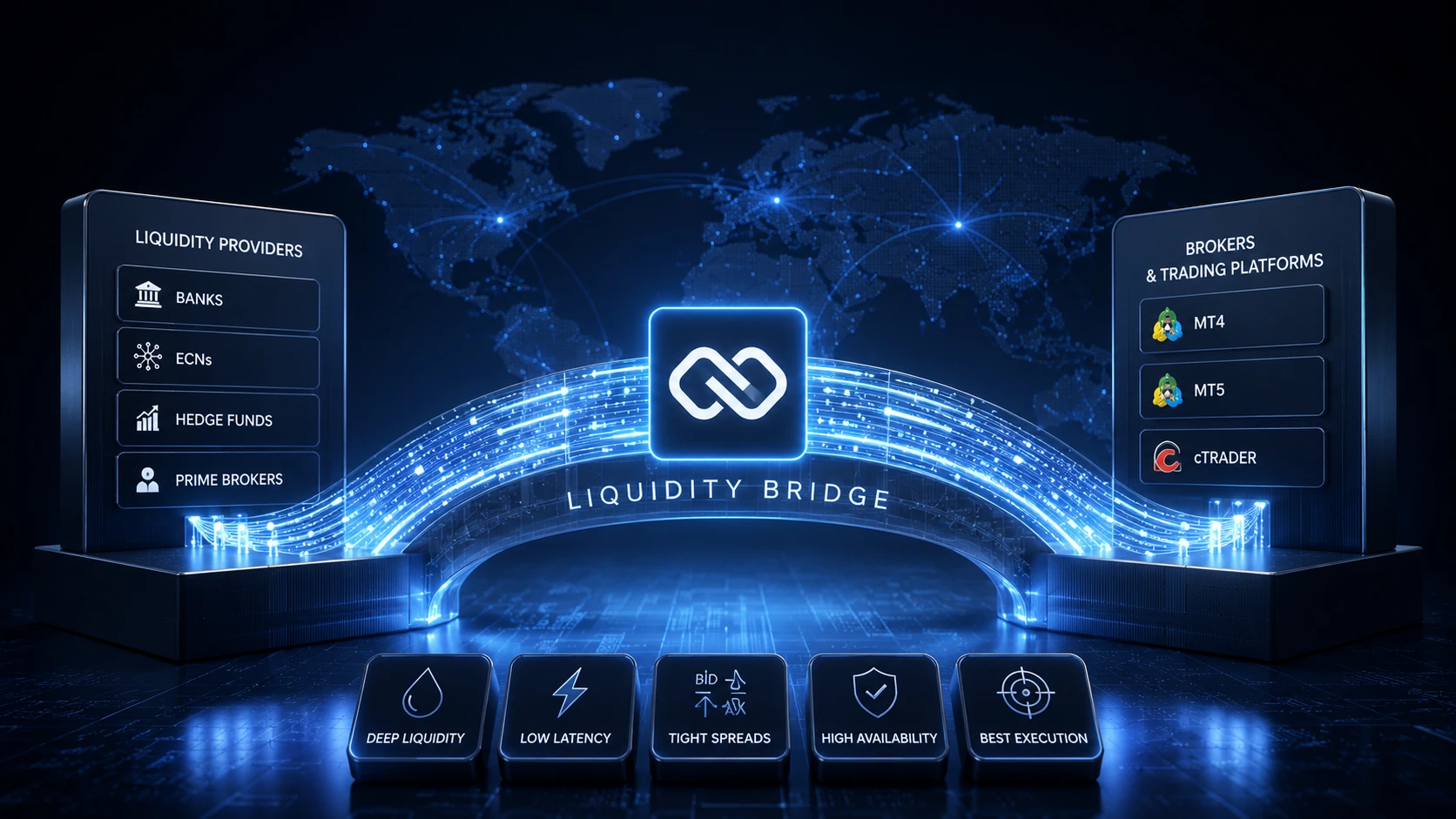
Competitive pricing and reliable execution begin with strong liquidity infrastructure. Our Liquidity Bridge connects your brokerage or trading platform with multiple liquidity providers, creating a flexible execution layer for receiving market pricing, aggregating liquidity, routing orders, and managing execution across connected sources.
Instead of depending on a single liquidity provider, the bridge can combine pricing and liquidity from multiple sources to create a more competitive trading environment. Real-time price aggregation, intelligent order routing, A-book and B-book support, automated failover, execution monitoring, and risk-system integration work together to give brokers greater control over how orders are handled.
Built as a critical component of modern brokerage infrastructure, the Liquidity Bridge is designed to help brokers improve execution quality, manage provider relationships, monitor trading exposure, and maintain continuity even when individual liquidity sources experience interruptions.
Multi-Provider Liquidity Connectivity
A modern brokerage may work with multiple banks, prime brokers, non-bank liquidity providers, market makers, or other execution sources. The Liquidity Bridge provides the connectivity layer required to bring these sources together.
Each provider can be connected through the appropriate technical protocol or API, allowing your brokerage to manage multiple liquidity relationships from a centralized execution environment.
Real-Time Price Aggregation
Connecting multiple liquidity sources creates the opportunity to aggregate pricing into a consolidated market view.
The bridge can receive bid and ask prices from connected providers in real time, compare available quotes, and construct an aggregated pricing stream according to your configured rules. This helps brokers create competitive pricing while maintaining control over how liquidity is presented to clients.
Competitive Spread Management
Pricing directly affects the trading experience. By aggregating quotes from multiple providers, the bridge can identify competitive bid and ask prices across available sources.
Depending on the provider setup and configuration, this can help brokers offer tighter or more competitive spreads while maintaining appropriate markup and pricing rules for different client groups.
Smart Order Routing
Not every order should necessarily be sent to the same liquidity provider. Provider selection can depend on multiple factors, including price, available liquidity, execution speed, reliability, or broker-defined routing rules.
Smart order routing allows the bridge to automatically determine where an order should be directed based on predefined conditions. Routing logic can be customized around the brokerage's execution strategy and risk requirements.
Price-Based Routing
When pricing is the primary consideration, the routing engine can evaluate available provider quotes and prioritize the source offering the most competitive executable price under the configured rules.
This allows the brokerage to make more effective use of available liquidity while maintaining control over execution logic.
Speed-Based Routing
Execution speed can be particularly important for active traders and strategies that depend on rapid order processing.
Routing rules can prioritize providers based on observed or configured execution performance, helping direct orders toward liquidity sources capable of meeting the brokerage's desired execution requirements.
Reliability-Based Routing
A provider may offer competitive pricing but experience occasional connectivity or execution issues. Reliability-based routing allows the system to consider provider availability and operational performance when deciding where to send orders.
This creates a more resilient execution environment and reduces dependence on a single liquidity source.
A-Book Execution Model
The Liquidity Bridge supports A-book execution models, allowing brokers to route client trades directly to external liquidity providers according to their execution and risk-management strategy.
This enables the brokerage to connect client flow with external market liquidity while maintaining centralized control over routing, execution monitoring, and provider relationships.
B-Book Execution Model
The infrastructure can also support B-book workflows, where eligible client flow may be managed internally according to the brokerage's risk strategy.
This gives brokers flexibility in deciding how different categories of client flow should be handled, subject to their operating model, internal policies, and applicable regulatory requirements.
Hybrid A-Book and B-Book Routing
Many brokerages use a hybrid approach rather than routing every client order through a single execution model.
The bridge can support configurable routing logic that allows eligible orders or client segments to follow different execution paths. Routing can be based on factors such as account type, instrument, volume, client segment, risk profile, trading behavior, or other business-defined criteria.
Automated Failover
Liquidity infrastructure needs to remain operational even when an individual provider becomes unavailable.
Automated failover functionality can detect provider connectivity or execution issues and redirect eligible pricing or order flow to alternative liquidity sources according to predefined rules.
This helps reduce dependency on individual providers and supports greater continuity of pricing and execution.
Provider Health Monitoring
The bridge can continuously monitor the status and performance of connected liquidity providers.
Monitoring can include connectivity status, pricing availability, response times, rejected orders, execution quality, and other relevant operational indicators. This gives administrators greater visibility into the health of the execution environment.
Liquidity Provider Management
A centralized management environment allows administrators to configure and manage connected liquidity sources.
Provider settings can include connectivity details, routing priorities, supported instruments, execution parameters, pricing rules, failover preferences, and other configuration options required by the brokerage.
Instrument-Level Routing
Different instruments may require different liquidity sources. The bridge can support routing rules at the instrument level so brokers can determine which providers should handle particular asset classes or trading symbols.
This allows the execution infrastructure to reflect the liquidity characteristics of different markets.
Client-Specific Routing
Brokerages may also need different execution rules for different client groups.
Routing configurations can be designed around account types, client segments, trading conditions, geographic markets, or other business requirements, providing greater control over how client orders enter the liquidity environment.
Volume-Based Routing
Large orders can create different execution requirements from standard retail trades. Volume-based routing can direct orders according to predefined size thresholds and available liquidity.
This allows the brokerage to establish different routing paths for smaller and larger orders while maintaining centralized control over execution rules.
Liquidity Aggregation
Liquidity aggregation goes beyond simply combining prices. The bridge can consolidate available market depth from connected sources and present a unified liquidity environment.
This can provide access to greater aggregated depth and help the brokerage make more effective use of available liquidity across multiple providers.
Market Depth Management
For businesses requiring deeper market visibility, the system can process multiple levels of bid and ask liquidity from connected sources.
Aggregated market depth can help brokers understand available liquidity at different price levels and support more sophisticated execution and pricing strategies.
Dynamic Pricing
Market conditions change continuously, so pricing infrastructure needs to respond in real time.
The bridge can process incoming provider quotes and update the aggregated pricing environment as market conditions change. Configurable pricing rules can also be used to apply markups, spreads, or other broker-defined adjustments where appropriate.
Spread Markup Management
Brokerages may operate different pricing models for different account types or client segments. The bridge can support configurable markup structures that allow administrators to define how provider pricing is transformed into client-facing pricing.
This creates flexibility for standard, premium, institutional, or other account structures.
Execution Quality Monitoring
Understanding where and how trades are executed is essential for maintaining operational quality.
The bridge can track execution information across providers, allowing brokers to evaluate fill rates, response times, rejected orders, slippage, and other execution metrics.
Fill Rate Reporting
Fill rates provide important insight into provider performance. Detailed reporting can show how frequently orders are successfully filled and how different liquidity sources perform across trading conditions.
This information can help brokers identify providers that consistently meet their execution requirements.
Slippage Analysis
Slippage can have a meaningful impact on trading outcomes. The bridge can capture execution information that allows brokers to compare requested and executed prices.
Historical slippage analysis can then help identify patterns across providers, instruments, account types, market conditions, and order sizes.
Rejection Monitoring
Order rejections can disrupt the client trading experience and create operational challenges.
The system can record rejected orders and relevant provider responses, giving administrators greater visibility into rejection patterns and helping them identify potential connectivity, liquidity, or routing issues.
Execution Reporting
Comprehensive execution reporting provides a detailed view of trading activity across the liquidity network.
Reports can include order timestamps, requested prices, executed prices, provider information, execution status, routing decisions, fill information, slippage, and other relevant execution data.
Real-Time Exposure Monitoring
Liquidity management is closely connected to risk management. The bridge can integrate with risk systems to provide visibility into aggregate exposure across connected liquidity providers.
This allows brokers to monitor how much exposure is being directed to each provider and identify concentration or risk-management issues more effectively.
Risk System Integration
The bridge can connect with existing brokerage risk-management infrastructure through APIs or other supported integration methods.
Risk systems can receive execution, position, exposure, and account-flow information, allowing the brokerage to maintain a more centralized view of market and client risk.
Aggregate Exposure Management
When client orders are distributed across multiple liquidity providers, understanding total exposure becomes increasingly important.
The bridge can consolidate relevant execution and exposure data across connected sources, helping risk teams understand the brokerage's overall liquidity and execution position.
Automated Routing Rules
Routing does not need to remain static. Brokers can establish rules that automatically determine how orders should be distributed based on predefined criteria.
These rules can be adjusted as provider performance, market conditions, liquidity availability, or business requirements change.
Redundant Connectivity
A resilient execution environment requires more than one connection path. Multiple liquidity connections provide redundancy and reduce the operational impact of individual provider outages.
The bridge can maintain multiple active or standby provider connections, allowing the brokerage to establish a more resilient liquidity architecture.
Trading Platform Integration
The Liquidity Bridge can be integrated with supported trading platforms and brokerage systems, creating a connection between client order flow and external liquidity.
This allows orders originating from trading terminals, web platforms, mobile applications, or other supported interfaces to enter the configured execution workflow.
API and Protocol Integration
Liquidity providers may use different technical connectivity standards. The bridge can be designed to work with supported APIs, trading protocols, and integration interfaces required by the selected providers.
This creates a centralized connectivity layer rather than forcing the brokerage to develop and maintain separate execution logic for every liquidity relationship.
Centralized Administration
Administrators can manage liquidity sources, routing rules, pricing settings, failover configurations, and execution parameters from a centralized environment.
A unified control layer makes it easier for technical, dealing, risk, and operational teams to manage the brokerage's execution infrastructure.
Detailed Audit Trails
Execution environments require reliable records of important events. The bridge can maintain audit-oriented records covering orders, routing decisions, provider responses, execution results, configuration changes, and system events.
These records can support operational investigations, internal reviews, reconciliation, and compliance processes where applicable.
Reconciliation Support
Accurate reconciliation is essential when dealing with multiple external liquidity sources.
Execution and transaction records can be organized to support comparison between internal brokerage records and provider-side information, helping operational teams identify discrepancies and investigate differences more efficiently.
Monitoring and Alerts
Automated alerts can notify administrators when important execution or connectivity events occur.
Potential alert conditions can include provider disconnections, abnormal latency, elevated rejection rates, pricing interruptions, unusual slippage, failover events, or other predefined operational thresholds.
Performance Analytics
Historical performance data allows brokers to compare liquidity providers objectively.
Analytics can help evaluate pricing quality, fill rates, execution speed, rejection rates, slippage, availability, and other metrics over selected periods. This supports data-driven decisions about provider allocation and routing priorities.
Provider Performance Comparison
When multiple liquidity providers are connected, comparing their performance becomes an important part of execution management.
The platform can provide comparative reporting so brokers can identify which providers perform best under different instruments, order sizes, market conditions, and trading periods.
Scalable Liquidity Infrastructure
As a brokerage grows, its liquidity requirements can become more complex. More clients, greater trading volume, additional instruments, and new geographic markets may require additional liquidity relationships.
The Liquidity Bridge provides an extensible infrastructure that can support additional providers, routing rules, instruments, and execution workflows as the business expands.
Built for Modern Brokerage Operations
Liquidity is not simply a connection to a provider. It is an operational ecosystem involving pricing, execution, routing, risk, monitoring, reporting, and failover.
Our Liquidity Bridge brings these components together into a centralized execution layer designed to give brokers greater control over how liquidity enters their platform and how client orders are managed.
Designed Around Your Execution Strategy
Every brokerage has different liquidity requirements. Some prioritize the tightest available pricing, while others may prioritize execution reliability, depth, speed, or provider diversification.
The bridge can be configured around your specific execution strategy, allowing routing priorities, provider relationships, account structures, pricing models, and risk requirements to work together within one infrastructure.
Build a More Resilient Execution Environment
Reliable liquidity infrastructure gives brokers greater flexibility in how they manage pricing and execution. By connecting multiple providers, aggregating liquidity, intelligently routing orders, monitoring execution quality, and maintaining automated failover, your brokerage can create a stronger foundation for day-to-day trading operations.
The goal is not simply to connect more providers. It is to create an execution environment where every liquidity relationship can be monitored, measured, and managed strategically.
Build the Liquidity Infrastructure Behind Better Execution
Your clients expect competitive pricing, reliable order execution, and a trading environment that remains available when markets move quickly. Your dealing and risk teams need visibility into provider performance and aggregate exposure. Your technology infrastructure needs the flexibility to support growth without becoming unnecessarily complex.
Our Liquidity Bridge connects these requirements through a centralized, intelligent liquidity and execution layer.
Connect multiple liquidity providers. Aggregate competitive pricing. Route orders intelligently, support A-book and B-book models, monitor execution quality, and build resilient liquidity infrastructure designed for performance, control, and scalable brokerage growth.
Product description
Learn more about product features and benefits
Liquidity Bridge
Competitive pricing and reliable execution begin with strong liquidity infrastructure. Our Liquidity Bridge connects your brokerage or trading platform with multiple liquidity providers, creating a flexible execution layer for receiving market pricing, aggregating liquidity, routing orders, and managing execution across connected sources.
Instead of depending on a single liquidity provider, the bridge can combine pricing and liquidity from multiple sources to create a more competitive trading environment. Real-time price aggregation, intelligent order routing, A-book and B-book support, automated failover, execution monitoring, and risk-system integration work together to give brokers greater control over how orders are handled.
Built as a critical component of modern brokerage infrastructure, the Liquidity Bridge is designed to help brokers improve execution quality, manage provider relationships, monitor trading exposure, and maintain continuity even when individual liquidity sources experience interruptions.
Multi-Provider Liquidity Connectivity
A modern brokerage may work with multiple banks, prime brokers, non-bank liquidity providers, market makers, or other execution sources. The Liquidity Bridge provides the connectivity layer required to bring these sources together.
Each provider can be connected through the appropriate technical protocol or API, allowing your brokerage to manage multiple liquidity relationships from a centralized execution environment.
Real-Time Price Aggregation
Connecting multiple liquidity sources creates the opportunity to aggregate pricing into a consolidated market view.
The bridge can receive bid and ask prices from connected providers in real time, compare available quotes, and construct an aggregated pricing stream according to your configured rules. This helps brokers create competitive pricing while maintaining control over how liquidity is presented to clients.
Competitive Spread Management
Pricing directly affects the trading experience. By aggregating quotes from multiple providers, the bridge can identify competitive bid and ask prices across available sources.
Depending on the provider setup and configuration, this can help brokers offer tighter or more competitive spreads while maintaining appropriate markup and pricing rules for different client groups.
Smart Order Routing
Not every order should necessarily be sent to the same liquidity provider. Provider selection can depend on multiple factors, including price, available liquidity, execution speed, reliability, or broker-defined routing rules.
Smart order routing allows the bridge to automatically determine where an order should be directed based on predefined conditions. Routing logic can be customized around the brokerage's execution strategy and risk requirements.
Price-Based Routing
When pricing is the primary consideration, the routing engine can evaluate available provider quotes and prioritize the source offering the most competitive executable price under the configured rules.
This allows the brokerage to make more effective use of available liquidity while maintaining control over execution logic.
Speed-Based Routing
Execution speed can be particularly important for active traders and strategies that depend on rapid order processing.
Routing rules can prioritize providers based on observed or configured execution performance, helping direct orders toward liquidity sources capable of meeting the brokerage's desired execution requirements.
Reliability-Based Routing
A provider may offer competitive pricing but experience occasional connectivity or execution issues. Reliability-based routing allows the system to consider provider availability and operational performance when deciding where to send orders.
This creates a more resilient execution environment and reduces dependence on a single liquidity source.
A-Book Execution Model
The Liquidity Bridge supports A-book execution models, allowing brokers to route client trades directly to external liquidity providers according to their execution and risk-management strategy.
This enables the brokerage to connect client flow with external market liquidity while maintaining centralized control over routing, execution monitoring, and provider relationships.
B-Book Execution Model
The infrastructure can also support B-book workflows, where eligible client flow may be managed internally according to the brokerage's risk strategy.
This gives brokers flexibility in deciding how different categories of client flow should be handled, subject to their operating model, internal policies, and applicable regulatory requirements.
Hybrid A-Book and B-Book Routing
Many brokerages use a hybrid approach rather than routing every client order through a single execution model.
The bridge can support configurable routing logic that allows eligible orders or client segments to follow different execution paths. Routing can be based on factors such as account type, instrument, volume, client segment, risk profile, trading behavior, or other business-defined criteria.
Automated Failover
Liquidity infrastructure needs to remain operational even when an individual provider becomes unavailable.
Automated failover functionality can detect provider connectivity or execution issues and redirect eligible pricing or order flow to alternative liquidity sources according to predefined rules.
This helps reduce dependency on individual providers and supports greater continuity of pricing and execution.
Provider Health Monitoring
The bridge can continuously monitor the status and performance of connected liquidity providers.
Monitoring can include connectivity status, pricing availability, response times, rejected orders, execution quality, and other relevant operational indicators. This gives administrators greater visibility into the health of the execution environment.
Liquidity Provider Management
A centralized management environment allows administrators to configure and manage connected liquidity sources.
Provider settings can include connectivity details, routing priorities, supported instruments, execution parameters, pricing rules, failover preferences, and other configuration options required by the brokerage.
Instrument-Level Routing
Different instruments may require different liquidity sources. The bridge can support routing rules at the instrument level so brokers can determine which providers should handle particular asset classes or trading symbols.
This allows the execution infrastructure to reflect the liquidity characteristics of different markets.
Client-Specific Routing
Brokerages may also need different execution rules for different client groups.
Routing configurations can be designed around account types, client segments, trading conditions, geographic markets, or other business requirements, providing greater control over how client orders enter the liquidity environment.
Volume-Based Routing
Large orders can create different execution requirements from standard retail trades. Volume-based routing can direct orders according to predefined size thresholds and available liquidity.
This allows the brokerage to establish different routing paths for smaller and larger orders while maintaining centralized control over execution rules.
Liquidity Aggregation
Liquidity aggregation goes beyond simply combining prices. The bridge can consolidate available market depth from connected sources and present a unified liquidity environment.
This can provide access to greater aggregated depth and help the brokerage make more effective use of available liquidity across multiple providers.
Market Depth Management
For businesses requiring deeper market visibility, the system can process multiple levels of bid and ask liquidity from connected sources.
Aggregated market depth can help brokers understand available liquidity at different price levels and support more sophisticated execution and pricing strategies.
Dynamic Pricing
Market conditions change continuously, so pricing infrastructure needs to respond in real time.
The bridge can process incoming provider quotes and update the aggregated pricing environment as market conditions change. Configurable pricing rules can also be used to apply markups, spreads, or other broker-defined adjustments where appropriate.
Spread Markup Management
Brokerages may operate different pricing models for different account types or client segments. The bridge can support configurable markup structures that allow administrators to define how provider pricing is transformed into client-facing pricing.
This creates flexibility for standard, premium, institutional, or other account structures.
Execution Quality Monitoring
Understanding where and how trades are executed is essential for maintaining operational quality.
The bridge can track execution information across providers, allowing brokers to evaluate fill rates, response times, rejected orders, slippage, and other execution metrics.
Fill Rate Reporting
Fill rates provide important insight into provider performance. Detailed reporting can show how frequently orders are successfully filled and how different liquidity sources perform across trading conditions.
This information can help brokers identify providers that consistently meet their execution requirements.
Slippage Analysis
Slippage can have a meaningful impact on trading outcomes. The bridge can capture execution information that allows brokers to compare requested and executed prices.
Historical slippage analysis can then help identify patterns across providers, instruments, account types, market conditions, and order sizes.
Rejection Monitoring
Order rejections can disrupt the client trading experience and create operational challenges.
The system can record rejected orders and relevant provider responses, giving administrators greater visibility into rejection patterns and helping them identify potential connectivity, liquidity, or routing issues.
Execution Reporting
Comprehensive execution reporting provides a detailed view of trading activity across the liquidity network.
Reports can include order timestamps, requested prices, executed prices, provider information, execution status, routing decisions, fill information, slippage, and other relevant execution data.
Real-Time Exposure Monitoring
Liquidity management is closely connected to risk management. The bridge can integrate with risk systems to provide visibility into aggregate exposure across connected liquidity providers.
This allows brokers to monitor how much exposure is being directed to each provider and identify concentration or risk-management issues more effectively.
Risk System Integration
The bridge can connect with existing brokerage risk-management infrastructure through APIs or other supported integration methods.
Risk systems can receive execution, position, exposure, and account-flow information, allowing the brokerage to maintain a more centralized view of market and client risk.
Aggregate Exposure Management
When client orders are distributed across multiple liquidity providers, understanding total exposure becomes increasingly important.
The bridge can consolidate relevant execution and exposure data across connected sources, helping risk teams understand the brokerage's overall liquidity and execution position.
Automated Routing Rules
Routing does not need to remain static. Brokers can establish rules that automatically determine how orders should be distributed based on predefined criteria.
These rules can be adjusted as provider performance, market conditions, liquidity availability, or business requirements change.
Redundant Connectivity
A resilient execution environment requires more than one connection path. Multiple liquidity connections provide redundancy and reduce the operational impact of individual provider outages.
The bridge can maintain multiple active or standby provider connections, allowing the brokerage to establish a more resilient liquidity architecture.
Trading Platform Integration
The Liquidity Bridge can be integrated with supported trading platforms and brokerage systems, creating a connection between client order flow and external liquidity.
This allows orders originating from trading terminals, web platforms, mobile applications, or other supported interfaces to enter the configured execution workflow.
API and Protocol Integration
Liquidity providers may use different technical connectivity standards. The bridge can be designed to work with supported APIs, trading protocols, and integration interfaces required by the selected providers.
This creates a centralized connectivity layer rather than forcing the brokerage to develop and maintain separate execution logic for every liquidity relationship.
Centralized Administration
Administrators can manage liquidity sources, routing rules, pricing settings, failover configurations, and execution parameters from a centralized environment.
A unified control layer makes it easier for technical, dealing, risk, and operational teams to manage the brokerage's execution infrastructure.
Detailed Audit Trails
Execution environments require reliable records of important events. The bridge can maintain audit-oriented records covering orders, routing decisions, provider responses, execution results, configuration changes, and system events.
These records can support operational investigations, internal reviews, reconciliation, and compliance processes where applicable.
Reconciliation Support
Accurate reconciliation is essential when dealing with multiple external liquidity sources.
Execution and transaction records can be organized to support comparison between internal brokerage records and provider-side information, helping operational teams identify discrepancies and investigate differences more efficiently.
Monitoring and Alerts
Automated alerts can notify administrators when important execution or connectivity events occur.
Potential alert conditions can include provider disconnections, abnormal latency, elevated rejection rates, pricing interruptions, unusual slippage, failover events, or other predefined operational thresholds.
Performance Analytics
Historical performance data allows brokers to compare liquidity providers objectively.
Analytics can help evaluate pricing quality, fill rates, execution speed, rejection rates, slippage, availability, and other metrics over selected periods. This supports data-driven decisions about provider allocation and routing priorities.
Provider Performance Comparison
When multiple liquidity providers are connected, comparing their performance becomes an important part of execution management.
The platform can provide comparative reporting so brokers can identify which providers perform best under different instruments, order sizes, market conditions, and trading periods.
Scalable Liquidity Infrastructure
As a brokerage grows, its liquidity requirements can become more complex. More clients, greater trading volume, additional instruments, and new geographic markets may require additional liquidity relationships.
The Liquidity Bridge provides an extensible infrastructure that can support additional providers, routing rules, instruments, and execution workflows as the business expands.
Built for Modern Brokerage Operations
Liquidity is not simply a connection to a provider. It is an operational ecosystem involving pricing, execution, routing, risk, monitoring, reporting, and failover.
Our Liquidity Bridge brings these components together into a centralized execution layer designed to give brokers greater control over how liquidity enters their platform and how client orders are managed.
Designed Around Your Execution Strategy
Every brokerage has different liquidity requirements. Some prioritize the tightest available pricing, while others may prioritize execution reliability, depth, speed, or provider diversification.
The bridge can be configured around your specific execution strategy, allowing routing priorities, provider relationships, account structures, pricing models, and risk requirements to work together within one infrastructure.
Build a More Resilient Execution Environment
Reliable liquidity infrastructure gives brokers greater flexibility in how they manage pricing and execution. By connecting multiple providers, aggregating liquidity, intelligently routing orders, monitoring execution quality, and maintaining automated failover, your brokerage can create a stronger foundation for day-to-day trading operations.
The goal is not simply to connect more providers. It is to create an execution environment where every liquidity relationship can be monitored, measured, and managed strategically.
Build the Liquidity Infrastructure Behind Better Execution
Your clients expect competitive pricing, reliable order execution, and a trading environment that remains available when markets move quickly. Your dealing and risk teams need visibility into provider performance and aggregate exposure. Your technology infrastructure needs the flexibility to support growth without becoming unnecessarily complex.
Our Liquidity Bridge connects these requirements through a centralized, intelligent liquidity and execution layer.
Connect multiple liquidity providers. Aggregate competitive pricing. Route orders intelligently, support A-book and B-book models, monitor execution quality, and build resilient liquidity infrastructure designed for performance, control, and scalable brokerage growth.
Product specification
Quick product information

No review given yet!